Key takeaways
- Go central, not cornered: A dehumidifier pulls air in and pushes it back out, so it needs a full circuit. Set it near the middle of the space or along an open wall, and keep 8 to 12 inches of clearance on every side. Corners and alcoves let the unit re-breathe its own dry air while the far side of the room stays damp.
- Work the low ground: Cool, moisture-heavy air settles. In a split-level porch or a basement where you overwinter cushions and umbrellas, the lowest point in the space is where the problem concentrates, and that is where the intake should sit.
- Chase the source: If the damp is coming from a specific place, a sliding door that sweats, a hot tub surround, a laundry wall, position the unit within a few feet of it and let it intercept the moisture before it spreads into your upholstery.
- Plan the water exit first: Any space you don’t visit daily needs gravity drainage to a floor drain or sump. Pick the location by where the hose can run downhill, then arrange furniture around it. Tank-only units belong in rooms you pass through regularly.
- Respect the surface and the noise: Level hard flooring, never carpet or a rug that blocks the base vents. For sleeping porches and reading nooks, look for a sleep mode and a dimmable light so the unit disappears at night.
What's inside
Anyone who spends real time on a screened porch, in a sunroom, or shuffling cushions in and out of a garage knows the smell of trapped moisture before they ever see the damage. Cane and rattan swell, teak grows a grey film, storage benches turn into petri dishes, and the wicker sectional you paid a premium for starts to feel faintly damp to the touch. Buying a dehumidifier solves half the problem. The other half is putting it somewhere it can actually do its job, and that is where most people quietly lose the battle. A unit shoved into a corner behind a plant stand will run for years and never earn its keep.
This guide approaches placement the way we approach an outdoor room: airflow first, moisture source second, aesthetics third. Below you’ll find the models we return to for three-season rooms, enclosed patios, basements that store patio furniture over winter, and the transitional spaces where indoor and outdoor living overlap. We cover tank capacity versus continuous drainage, clearance requirements, and the specific spots in a room that give you the fastest drop in relative humidity.
As an Amazon Associate we earn from qualifying purchases.


How to Choose a Place To Place A Dehumidifier (2026)
- Go central, not cornered: A dehumidifier pulls air in and pushes it back out, so it needs a full circuit. Set it near the middle of the space or along an open wall, and keep 8 to 12 inches of clearance on every side. Corners and alcoves let the unit re-breathe its own dry air while the far side of the room stays damp.
- Work the low ground: Cool, moisture-heavy air settles. In a split-level porch or a basement where you overwinter cushions and umbrellas, the lowest point in the space is where the problem concentrates, and that is where the intake should sit.
- Chase the source: If the damp is coming from a specific place, a sliding door that sweats, a hot tub surround, a laundry wall, position the unit within a few feet of it and let it intercept the moisture before it spreads into your upholstery.
- Plan the water exit first: Any space you don’t visit daily needs gravity drainage to a floor drain or sump. Pick the location by where the hose can run downhill, then arrange furniture around it. Tank-only units belong in rooms you pass through regularly.
- Respect the surface and the noise: Level hard flooring, never carpet or a rug that blocks the base vents. For sleeping porches and reading nooks, look for a sleep mode and a dimmable light so the unit disappears at night.
The Best Place To Place A Dehumidifier (2026)s Reviewed
ToLife 95 oz Dehumidifier, 1000 Sq Ft
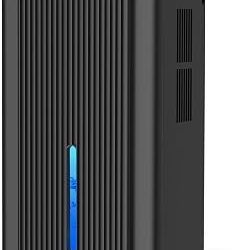
The one we recommend most often for enclosed porches and sunrooms up to about 1,000 square feet, largely because the 95 oz tank means you can set it on a side table or plinth rather than hunting for a drain. Sleep mode and the seven-color LED make it easy to live with in a room you actually relax in.
95OZ Dehumidifier for Home, 1000 sq ft (Black)
Same class of performance in a matte black finish that reads as furniture rather than appliance, which matters when your porch palette is dark aluminum and charcoal cushions. Auto shut-off protects it if the tank fills while you’re away for the weekend.
Waykar 80 Pint, 5000 Sq. Ft Energy Star
Our pick for whole-lower-level control, especially basements doubling as off-season storage for patio sets. The 90-degree auto swing louver spreads dry air across a wide footprint instead of one lane, and continuous drainage plus auto-defrost means it runs unattended through cold, damp months.
KNKA Energy Star 4500 Sq. Ft, 80 Pint/Day
A strong value in the large-capacity tier, with a drain hose included and smart humidity control that holds a target rather than cycling blindly. Set it to 50 percent in a garage or workshop and it will quietly protect cushions, canvas, and tools all season.
4500 Sq. Ft Compressor Dehumidifier with Drain Hose
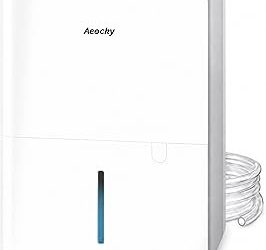
Built around an efficient compressor with intelligent humidity control, this is the workhorse for utility-forward spaces, mudrooms, basements, potting rooms, where you want capacity and a permanent drain more than you want looks.
Frequently Asked Questions
Can I use a dehumidifier on an open porch or patio?
Not effectively. Dehumidifiers need a reasonably sealed envelope, otherwise they’ll dry outdoor air indefinitely. Screened rooms with vinyl or acrylic panels closed are fine; fully open patios are not.
How far from the wall does it need to be?
Check your model, but 8 to 12 inches of clearance on the intake and exhaust sides is a safe default. Blocking either side reduces output and makes the compressor work harder than it should.
Should it run near my outdoor furniture storage?
Yes, but not pressed against it. Give stacked cushions and folded umbrellas a foot of breathing room so the dry airstream can circulate around them rather than hitting a wall of fabric.
What humidity level protects wicker and teak?
Aim for 45 to 55 percent. Below 40 percent, natural rattan and cane can dry out and become brittle; above 60 percent, mildew takes hold quickly.
Final Thoughts
For a sunroom or three-season porch you use daily, the ToLife 95 oz is the easiest unit to place and live with. If you’re protecting a basement full of off-season patio furniture, the Waykar 80 Pint earns the upgrade with its swing louver and continuous drainage, while the KNKA Energy Star 80 Pint delivers nearly the same coverage for less. Whichever you choose, give it room to breathe and a clear path for the water.