Key takeaways
- Turn the fan off and let the blades come to a full stop before you touch them. On a reversible outdoor fan, note the seasonal switch position so you can restore it afterward.
- Lay an old sheet or drop cloth over patio furniture and grill surfaces first — retrieving dust from outdoor cushion seams is far worse than preventing it.
- Wash microfiber sleeves separately, cold, with no fabric softener. Softener coats the fibers and kills their static grip permanently.
- Support each blade lightly with your free hand where you can reach it. Pressing hard on an unsupported blade tip is a common cause of new wobble.
What's inside
- Our Recommended Picks
- Identify What’s Actually on the Blades First
- Match the Tool to Your Ceiling Height and Shape
- Use a Pincer Head to Trap Dust Instead of Scattering It
- Don’t Skip the Housing, Downrod, and Blade Brackets
- Set a Realistic Frequency for Your Climate
- Tips
- Frequently Asked Questions
- Conclusion
Ceiling fans live in the one part of a room nobody inspects: the airspace above eye level. Indoors that means a slow accumulation of lint and skin cells. Out on a covered porch, screened lanai, or under a pergola, it’s a different animal entirely — pollen drifts in on spring air, cottonwood fluff sticks to blade edges, cooking grease from the grill migrates upward, and near the coast a fine salt film binds it all into something closer to paste than dust. That layer isn’t just unsightly. Uneven buildup on one blade throws the whole rotor out of balance, which is where most porch-fan wobble and bearing chatter actually starts.
- Our Recommended Picks
- Identify What’s Actually on the Blades First
- Match the Tool to Your Ceiling Height and Shape
- Use a Pincer Head to Trap Dust Instead of Scattering It
- Don’t Skip the Housing, Downrod, and Blade Brackets
- Set a Realistic Frequency for Your Climate
- Tips
- Frequently Asked Questions
- Conclusion
The good news: you almost never need a ladder, and you rarely need chemicals. Below I’ll walk through how to read the type of soil on your blades, the right tool geometry for high or sloped outdoor ceilings, a sequence that keeps debris off your cushions and dining table, and how often to repeat it depending on your climate. A few tools I keep in the shed are grouped just below.
Our Recommended Picks
As an Amazon Associate we earn from qualifying purchases.



Identify What’s Actually on the Blades First
Dry, fluffy dust lifts off with a microfiber sleeve and nothing else. Sticky film — the kind you get on a fan above an outdoor kitchen or in humid coastal air — will smear if you dry-dust it, driving grime into the blade’s finish. Run a fingertip along the trailing edge of one blade. If it comes away powdery, go dry. If it feels tacky or leaves a shine on your skin, you need a lightly dampened head and a second dry pass. Wood and faux-wood outdoor blades in particular hate standing moisture, so damp means barely damp, wrung out until nothing drips.
Match the Tool to Your Ceiling Height and Shape
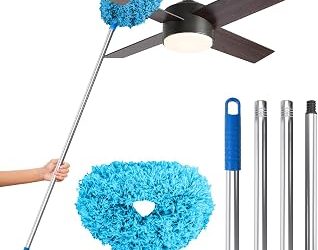
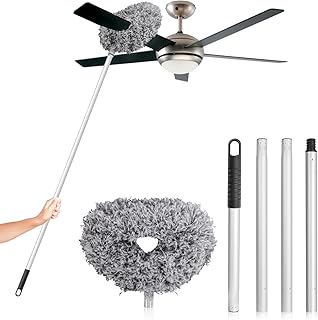
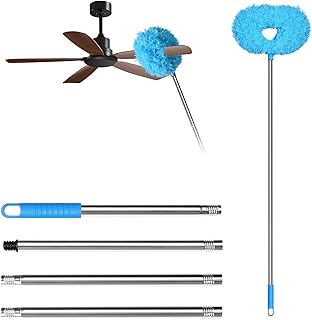
This is where most people buy wrong. Measure from the floor to the underside of the blades, subtract your own reach with an arm raised (roughly 7 feet for many adults), and buy a pole that comfortably exceeds that gap. Standard 8-to-9-foot porch ceilings are easily handled by a telescoping model such as the DRQ Ceiling Fan Cleaner Duster, which extends from 13 up to 48 inches and drops to a compact length for storage. Vaulted or gable porch ceilings need more runway — the Eyliden 68″ Adjustable Ceiling Fan Duster is built for ladderless work at that height and weighs about three quarters of a pound, which matters more than you’d think when your arm is overhead for several minutes. For fans mounted on a slope, look for a head that pivots so the sleeve stays flat against an angled blade rather than scraping at it with one corner.
Use a Pincer Head to Trap Dust Instead of Scattering It
A flat duster pushes debris off the blade and into the room. A U-shaped or dual-sided head wraps the blade so both faces get cleaned in a single pull, and the fibers hold what they collect. Models like the FONUNO Ceiling Fan Cleaner Duster and the Storystore Adjustable Microfiber Duster use this sleeve design with a 13-to-50-inch pole range, which covers the majority of residential fans. Work from the motor housing outward toward the blade tip, one blade at a time, and pull slowly — speed is what launches dust into the air. Shake the sleeve out into a bag outdoors between blades if the load is heavy.
Don’t Skip the Housing, Downrod, and Blade Brackets
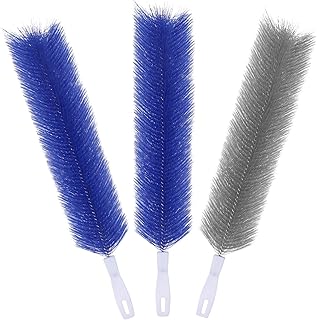
On outdoor fans, the motor housing and the top of the blade brackets collect the worst of it, and those cast-metal shapes defeat a big flat duster. A bendable cobweb brush handles them properly — a three-piece set of flexible microfiber brushes will get into the bracket seams, the downrod canopy, and the ventilation slots on the housing, and the same tool clears wasp and mud-dauber starts in the corners of a porch ceiling before they become a project. Check the pull chains too; grit works into those and eventually into the switch.
Set a Realistic Frequency for Your Climate
Indoor fans do fine at every four to six weeks. A covered outdoor fan needs more: monthly through pollen season, and every two to three weeks if you’re within a mile of salt water or running a smoker nearby. The tell is simple — if you can see a defined leading edge of buildup from the floor, you’re overdue. Twice-yearly deep cleaning, when the fan comes off summer duty and again before it goes back on, is a reasonable rhythm for most porches.
Tips
- Turn the fan off and let the blades come to a full stop before you touch them. On a reversible outdoor fan, note the seasonal switch position so you can restore it afterward.
- Lay an old sheet or drop cloth over patio furniture and grill surfaces first — retrieving dust from outdoor cushion seams is far worse than preventing it.
- Wash microfiber sleeves separately, cold, with no fabric softener. Softener coats the fibers and kills their static grip permanently.
- Support each blade lightly with your free hand where you can reach it. Pressing hard on an unsupported blade tip is a common cause of new wobble.
Frequently Asked Questions
Can I use furniture polish or all-purpose spray on fan blades?
Skip both. Polish leaves a residue that attracts dust faster than a bare blade, and solvent-based sprays can haze the sealed finish on outdoor-rated blades. Plain water on a wrung-out microfiber sleeve, or a drop of dish soap for greasy film, is all that’s needed.
Do I need to clean a damp-rated or wet-rated fan differently?
Wet-rated fans tolerate moisture on the blades, but the motor housing still shouldn’t be soaked. Damp-rated fans, which cover most covered-porch installations, should only ever see a barely moist cloth. Either way, dry the blades after a damp pass so nothing beads and sits.
Will a telescoping duster reach a two-story porch ceiling?
Most top out around 5 to 6 feet of pole, which handles ceilings up to roughly 12 feet from the floor. Beyond that you’re into ladder territory, or a dedicated extension-pole system. Working overhead at full extension also gets tiring quickly, so lightweight designs are worth the small premium.
My fan still wobbles after cleaning. What now?
Check that every blade screw is snug at the bracket and that the bracket screws into the motor are tight. If it persists, a clip-on balancing kit will identify the heavy blade. Cleaning removes the most common cause of new wobble, but not warped blades — humidity swings can warp non-outdoor-rated blades used outside.
Conclusion
Dusting a ceiling fan well comes down to three decisions: reading whether the soil is dry or sticky, choosing a pole that reaches your specific ceiling without straining your shoulder, and using a wraparound head that captures debris rather than broadcasting it across the patio. Do that on a sensible schedule for your climate, give the housing and brackets the same attention as the blades, and your outdoor fan will move air quietly and look right from the seating below — which is really the only vantage point that counts.