Key takeaways
- Measure the channel, not the glass: Write down the clear opening width and the full sash height. Casement units are typically under 16 inches wide and over 23 inches tall, so a half inch of misjudgment is the difference between a clean fit and a return label.
- Match BTUs to sun exposure: Roughly 20 BTU per square foot is the baseline, then add 10 to 20 percent for west-facing walls, glass-heavy sunrooms, or any space with a poorly insulated roof above it.
- Decide: built-in or portable: A casement unit gives better efficiency and frees your floor space. A portable plus a slider kit wins on tenant-friendliness, off-season storage, and moving between rooms.
- Take sealing seriously: Vertical openings leak more air than horizontal ones because gravity works against foam and tape. Look for kits with rigid adjustable panels, weather-resistant fabric, and no coupler required at the hose end.
- Check inverter and smart controls: Inverter compressors modulate rather than cycling on and off, which cuts noise dramatically and trims energy use. Wi-Fi and voice control matter more than you think in a room you visit intermittently, like a screened porch.
What's inside
Vertical sliding windows are the quiet villain of summer comfort. They slide side to side instead of bottom to top, which leaves you with a tall, narrow opening that standard window air conditioners simply cannot straddle. Anyone who has tried to wedge a wide, boxy unit into a casement or slider knows the result: a gap stuffed with foam, a sagging chassis, and a monthly bill that reads like a mortgage payment. It is especially frustrating in the rooms people most want to cool, such as sunrooms, converted porches, garden-level dens, and the covered patio spaces that blur the line between indoors and out.
Good news: the market has finally caught up. This guide covers the two workable paths for a vertical slider, a purpose-built casement AC that stands tall in the channel, or a portable unit paired with a properly sealed vertical window kit. Below you will find a shortlist of units and kits worth your money in 2026, a buying checklist drawn from real installs, and answers to the questions that trip people up before they order.
As an Amazon Associate we earn from qualifying purchases.




How to Choose a/an Air Conditioner For Vertical Sliding Window (2026)
- Measure the channel, not the glass: Write down the clear opening width and the full sash height. Casement units are typically under 16 inches wide and over 23 inches tall, so a half inch of misjudgment is the difference between a clean fit and a return label.
- Match BTUs to sun exposure: Roughly 20 BTU per square foot is the baseline, then add 10 to 20 percent for west-facing walls, glass-heavy sunrooms, or any space with a poorly insulated roof above it.
- Decide: built-in or portable: A casement unit gives better efficiency and frees your floor space. A portable plus a slider kit wins on tenant-friendliness, off-season storage, and moving between rooms.
- Take sealing seriously: Vertical openings leak more air than horizontal ones because gravity works against foam and tape. Look for kits with rigid adjustable panels, weather-resistant fabric, and no coupler required at the hose end.
- Check inverter and smart controls: Inverter compressors modulate rather than cycling on and off, which cuts noise dramatically and trims energy use. Wi-Fi and voice control matter more than you think in a room you visit intermittently, like a screened porch.
The Best Air Conditioner For Vertical Sliding Window (2026)s Reviewed
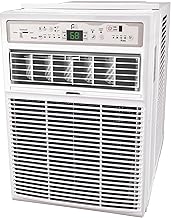
Perfect Aire 10,000 BTU Casement Window Air Conditioner
This is the honest answer for a true vertical slider: a tall, narrow chassis at 23.5 by 14.75 inches that drops into the channel without adapters or improvisation. The Follow Me remote reads temperature at your seat rather than at the unit, which makes a real difference in long, narrow rooms where cool air tends to pool near the window.
Midea 12,000 BTU U Shaped Window Air Conditioner
The U-shaped design saddles the sash and lets you close the window over the middle, which cuts street noise to a level most window units cannot approach. At 550 square feet of coverage and roughly 37 percent energy savings from the inverter compressor, it is the pick for larger sunrooms, though you will need a window that opens vertically or a slider adapted with a support frame.
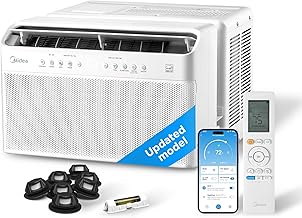
Midea 8,000 BTU U Shaped Smart Inverter Window Air Conditioner
Same clever architecture in a smaller footprint, sized for bedrooms, offices, and porch conversions up to 350 square feet. The Alexa and Google integration is genuinely useful for pre-cooling a space before guests arrive outside.
LOVIGA Portable Air Conditioner Window Kit
An adjustable seal panel spanning 40 to 64 inches, built for the vertical orientation with fully waterproof sealing. If you already own a portable unit, this is the cheapest route to a leak-free install, and the rigid construction holds up better than fabric-only alternatives through a full season.
Portable AC Window Vent Kit 5.9″ Seal Panel
A no-coupler design that fits both vertical and horizontal sliders, extending from 16.9 to 62.1 inches. Reinforced sealing at the panel seams keeps humid outside air from sneaking back in, which is where cheap kits quietly waste your cooling.
Frequently Asked Questions
Can a regular window AC work in a vertical sliding window?
Not safely. A standard unit is wider than it is tall and has nothing to brace against in a side-sliding channel. You need either a casement-style unit or a portable with a slider kit.
Do I need to build a support frame?
For casement units, usually no, though a bracket adds peace of mind on upper floors. For U-shaped units placed in an adapted slider, plan on a plywood or foam infill panel to carry the load.
How do I stop rain from getting in?
Use a waterproof seal panel and angle the unit slightly outward so condensate drains away from the sill. Silicone-free weather tape along the top edge handles wind-driven rain.
Are portable units less efficient?
Single-hose portables recirculate a bit of conditioned air, so expect slightly lower real-world performance than a comparable casement unit. A tight seal narrows the gap considerably.
Final Thoughts
For a genuine vertical slider, the Perfect Aire 10,000 BTU casement unit is the most straightforward install and the one I recommend first. If your opening allows a U-shaped design, the Midea 12,000 BTU is the quietest and most efficient way to cool a larger sunroom, with the 8,000 BTU version covering smaller spaces. Already own a portable? The LOVIGA window kit will get you sealed up properly for a fraction of the cost.