Key takeaways
- Power source: Decide between built-in rechargeable packs and units that accept tool batteries like the BL1850B. If you already own Makita or similar 18V batteries, adapter-style heaters give you swappable runtime instead of a single fixed charge.
- Realistic runtime: Capacity divided by draw tells the story. A 12,000mAh pack feeding a 170W element runs in minutes-to-an-hour territory, not all evening. Look for two heat settings so you can throttle down and stretch it.
- Aim and adjustability: 360-degree rotation and tilt matter more than raw wattage on a low-output heater. Being able to point warmth precisely at your hands or a fogged windshield is where these units earn their keep.
- Safety hardware: Anti-tilt shutoff, overheat protection, and a housing that stays cool to the touch are non-negotiable in a car, tent, or anywhere near fabric. Never run one inside a zipped enclosure unattended.
- Dual-purpose value: Many models double as fans in natural-wind mode and include USB ports for topping off a phone. That flexibility justifies the space in a truck box or camp bin far better than heating alone.
What's inside
Anyone who spends real time outdoors in the cold learns the same lesson twice: the first hour is fine, and the second one isn’t. Whether you’re waiting out a frost-covered windshield at 6 a.m., finishing trim work in an unheated garage, or reading on a screened porch in late October, the cold arrives from the edges — hands, ankles, the back of your neck. Plug-in heaters solve this beautifully, right up until there’s no outlet within a hundred feet.
That gap is what battery powered heaters are built for, and it’s worth being straight about what they do. A cordless unit running on a 12,000mAh pack or an 18V tool battery delivers roughly 150 to 200 watts — enough to push warm air at a person, a footwell, or a windshield, but nowhere near enough to raise the temperature of a room. Treat them as personal warmth and defrosting tools, not room heaters, and they’re genuinely useful. This guide covers what actually matters when you buy one, plus honest notes on the leading options for 2026.
As an Amazon Associate we earn from qualifying purchases.


How to Choose a Battery Powered Space Heater (2026)
- Power source: Decide between built-in rechargeable packs and units that accept tool batteries like the BL1850B. If you already own Makita or similar 18V batteries, adapter-style heaters give you swappable runtime instead of a single fixed charge.
- Realistic runtime: Capacity divided by draw tells the story. A 12,000mAh pack feeding a 170W element runs in minutes-to-an-hour territory, not all evening. Look for two heat settings so you can throttle down and stretch it.
- Aim and adjustability: 360-degree rotation and tilt matter more than raw wattage on a low-output heater. Being able to point warmth precisely at your hands or a fogged windshield is where these units earn their keep.
- Safety hardware: Anti-tilt shutoff, overheat protection, and a housing that stays cool to the touch are non-negotiable in a car, tent, or anywhere near fabric. Never run one inside a zipped enclosure unattended.
- Dual-purpose value: Many models double as fans in natural-wind mode and include USB ports for topping off a phone. That flexibility justifies the space in a truck box or camp bin far better than heating alone.
The Best Battery Powered Space Heaters (2026) Reviewed
5-Cell Cordless Heater with Dual USB and Anti-Tilt
The five-cell 3000mAh design keeps the footprint small enough for a cupholder or a camp table, and the anti-tilt shutoff is the feature that makes it tent-appropriate. Runtime is modest, so bring a power bank if you plan to use the USB ports too.
banapoy 200W Defroster with 2 Heat Settings
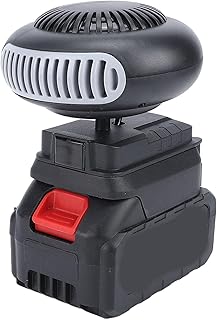
Built to run off BL1850B and BL1840B tool batteries, this is the pick for anyone with an existing 18V collection — swap packs and keep going instead of waiting on a recharge. The 200W output and low setting make it a capable windshield defroster and a reasonable hands-warmer at a jobsite.
Cordless 200W with Natural Wind and 360° Rotation
The dual-mode setup is smarter than it looks: natural wind mode turns it into a workshop fan in summer, so it isn’t dead weight nine months of the year. The 55°C and 85°C options give you a real choice between longer runtime and faster warmth.
CUIFATI Portable Car Heater and Defogger
The 360-degree rotation plus 160-degree tilt is the most flexible aiming setup in this group, which is exactly what you want when you’re clearing fog from an angled windshield. Best understood as a defogging and spot-warming tool rather than a cabin heater.
12000mAh Cordless Heater with 170W Output
The largest onboard battery here, and the one I’d choose for genuinely off-grid use — a porch, a tent vestibule, an ice-fishing shelter. Dual speeds let you dial back to preserve charge once you’ve taken the edge off.
Frequently Asked Questions
Can a battery powered heater warm an entire room?
No. Meaningful room heating needs 750 to 1,500 watts, and no portable battery sustains that for a useful stretch. These units warm people and small pockets of air, which is a different and much more achievable job.
How long will one actually run?
Expect roughly 20 to 60 minutes on high for most built-in-battery models, and longer on low or in fan mode. Tool-battery designs are limited only by how many charged packs you carry.
Are they safe to use in a tent or vehicle?
They’re safer than any fuel-burning heater because there’s no combustion and no carbon monoxide. Still keep clear space around the outlet, use models with tilt shutoff, and switch it off before you sleep.
Will one clear ice from my windshield?
It will handle interior fog and light frost with patience, particularly aimed close to the glass. Heavy exterior ice still needs a scraper and your engine’s defrost system.
Final Thoughts
For most outdoor-living use, the 12000mAh 170W cordless heater offers the best balance of runtime and portability, while the banapoy 200W defroster is the clear winner for anyone already invested in 18V tool batteries. If you want one unit that works year-round, the 200W model with natural wind mode and 360-degree rotation is the most versatile of the group.