Key takeaways
- Check the CFM number, not just the size: Aim for 5,000 CFM or better in a living room, and 7,000+ on an exposed patio where air escapes sideways. A 72-inch fan with a weak motor moves less air than a well-engineered 60-inch one.
- Favor DC motors: They draw roughly 60 to 70 percent less power than AC equivalents, run cooler, and give you six or more speeds instead of three. The low settings are genuinely usable for sleeping.
- Match the sweep to the room: Up to 200 square feet, a 52-inch fan is plenty. Between 200 and 400 square feet, step up to 60 inches. Above that, or for long covered porches, go 72 inches.
- Confirm the wet or damp rating: Damp-rated fans belong under a solid roof with no direct spray. If the fixture will see blowing rain, you need a wet-rated unit and sealed housing.
- Look for reversible rotation and a timer: Winter reverse pulls warm air down off the ceiling, and a sleep timer keeps the fan from running all night on a screened porch.
What's inside
Most people shopping for a fan fixate on blade span and finish, then wonder why the patio still feels stagnant in August. Air movement is a function of CFM (cubic feet per minute) paired with the right sweep for the space, and plenty of good-looking fans push a modest 3,000 CFM that barely stirs a cushion. On a covered porch or in a great room with vaulted ceilings, that shortfall is obvious within minutes.
This guide focuses on fans built to actually move air: high-CFM DC motors, wide sweeps from 52 to 72 inches, and damp-rated housings that hold up under a roofline. Below you will find a shortlist of models worth considering in 2026, the specs that separate a breeze from a whisper, and answers to the questions that come up most often during install.
As an Amazon Associate we earn from qualifying purchases.


How to Choose a Ceiling Fan To Move Air (2026)
- Check the CFM number, not just the size: Aim for 5,000 CFM or better in a living room, and 7,000+ on an exposed patio where air escapes sideways. A 72-inch fan with a weak motor moves less air than a well-engineered 60-inch one.
- Favor DC motors: They draw roughly 60 to 70 percent less power than AC equivalents, run cooler, and give you six or more speeds instead of three. The low settings are genuinely usable for sleeping.
- Match the sweep to the room: Up to 200 square feet, a 52-inch fan is plenty. Between 200 and 400 square feet, step up to 60 inches. Above that, or for long covered porches, go 72 inches.
- Confirm the wet or damp rating: Damp-rated fans belong under a solid roof with no direct spray. If the fixture will see blowing rain, you need a wet-rated unit and sealed housing.
- Look for reversible rotation and a timer: Winter reverse pulls warm air down off the ceiling, and a sleep timer keeps the fan from running all night on a screened porch.
The Best Ceiling Fans To Move Air (2026) Reviewed
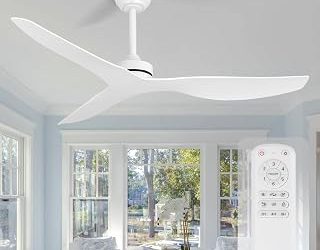
60 in Ceiling Fan, 7400+ CFM with Light and Remote
At north of 7,400 CFM from a 60-inch sweep, this is the airflow-per-inch leader here, and the three-blade design keeps the profile tidy on a mid-height porch ceiling. Six speeds, three color temperatures, and a timer make it flexible enough to serve as a year-round living room fixture too.
Minislak 72 Inch Ceiling Fan, No Light
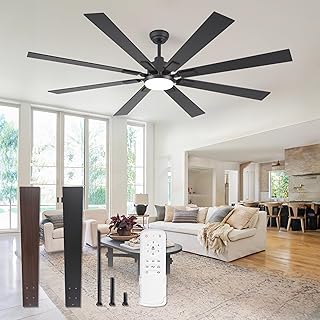
Eight aluminum blades on an industrial DC motor create a broad, low-turbulence column of air that suits garages, workshops, and deep covered patios. Skipping the light fixture is a deliberate advantage: less to seal against humidity, and it pairs cleanly with existing string lights or recessed cans.
ZMISHIBO 72″ Ceiling Fan with Light
This one earns its place through balance, delivering high CFM across a 72-inch sweep while keeping noise down and adding a 24W LED with three color temperatures. The dual-finish blades read as warm rather than industrial, which matters when the fan is the visual anchor of an outdoor room.
52 Inch Ceiling Fan, Matte Black and Gold
A strong choice when the fan needs to look intentional, with a matte black body and brushed gold accents that hold up against wood ceilings and darker siding. The three-blade layout and 52-inch span suit bedrooms, dining areas, and smaller patios where a 72-inch fan would overwhelm the space.
OPONL 52 Inch Ceiling Fan with Light
Six selectable color temperatures with full dimming give this model unusual range for evening use outdoors, shifting from bright task light to a soft glow. Reversible operation and a quiet motor make it a sensible all-season pick for a bedroom or three-season room.
Frequently Asked Questions
How much CFM do I need for a patio?
Covered outdoor spaces lose air at the edges, so plan on at least 30 to 50 percent more CFM than you would use indoors for the same square footage. For a typical 12-by-16-foot porch, look for 6,000 CFM or higher.
Can I install a damp-rated fan on an open deck?
Not safely. Damp-rated fans require overhead cover that blocks direct rain and snow. An uncovered deck calls for a wet-rated fan and, ideally, a GFCI-protected circuit.
Do more blades move more air?
Not by themselves. Blade count affects sound and smoothness more than raw output, while pitch, motor torque, and RPM determine CFM. A well-pitched three-blade fan often outperforms an eight-blade model with a weaker motor.
Will a big fan feel too strong indoors?
This is where DC motors pay off. Six or more speed steps mean a 72-inch fan can idle at a barely perceptible drift, then ramp up when the room fills with people.
Final Thoughts
For the strongest breeze in a standard-height space, the 60-inch 7,400+ CFM model is the most efficient use of sweep on this list. Larger rooms and long covered porches are better served by the ZMISHIBO 72-inch for its combination of airflow and lighting, or the Minislak 72-inch if you already have lighting handled and want pure air movement.