Key takeaways
- Carbon weight, not carbon presence: Nearly every purifier lists “activated carbon.” What separates real odor control from a token layer is the mass of it. A thin carbon-dusted mesh saturates in weeks; a granular bed measured in pounds keeps adsorbing for months. If a brand won’t publish the amount, assume it’s minimal.
- Turnover rate over headline coverage: Coverage figures often assume a single air change per hour, which is nowhere near enough for smoke. Halve or third the stated square footage so the unit cycles the room four to five times hourly. A purifier rated for 1,000 sq ft is a strong performer in a 300 sq ft sunroom.
- A sealed air path: Air takes the easiest route. If the housing leaks around the filter gasket, a portion of every pass bypasses the media entirely. Look for a compression-sealed filter seat rather than a filter that drops loosely into a tray.
- Filter economics over a year: Smoke shortens filter life dramatically. Price the replacements, multiply by the honest replacement cadence, and compare that annual figure — not the purchase price — across models. A cheaper unit with pricey proprietary cartridges frequently loses.
- Quiet output you’ll actually use: A purifier parked on low because high is unbearable is a purifier doing a fraction of its job. Check the low and mid speed noise figures, since those are the settings that run overnight in a bedroom or adjacent porch.
What's inside
Tobacco smoke is two problems wearing one coat. There is the particulate half — ultrafine solids small enough to slip past most cheap filter media and hang in the air for hours — and the gas half, a stew of volatile compounds that never settles because it was never solid to begin with. That second half is why a room can look clear and still smell like last night. On a furnished porch, sunroom, or three-season space, those gases bind to the softest thing available: cushion foam, woven rattan, canvas drapery, sisal rug backing. The furniture becomes the ashtray.
Anyone who designs transitional indoor-outdoor rooms runs into this constantly. Smoke drifts from a screened porch back through a slider, or a covered patio doubles as the household smoking spot and the odor migrates indoors on every temperature swing. This guide covers the purifiers worth putting in those rooms — what actually matters in the spec sheet, which units earn their filter cost, and how to place them so they intercept smoke instead of chasing it.
As an Amazon Associate we earn from qualifying purchases.


How to Choose a Cigarette Smoke Air Purifier (2026)
- Carbon weight, not carbon presence: Nearly every purifier lists “activated carbon.” What separates real odor control from a token layer is the mass of it. A thin carbon-dusted mesh saturates in weeks; a granular bed measured in pounds keeps adsorbing for months. If a brand won’t publish the amount, assume it’s minimal.
- Turnover rate over headline coverage: Coverage figures often assume a single air change per hour, which is nowhere near enough for smoke. Halve or third the stated square footage so the unit cycles the room four to five times hourly. A purifier rated for 1,000 sq ft is a strong performer in a 300 sq ft sunroom.
- A sealed air path: Air takes the easiest route. If the housing leaks around the filter gasket, a portion of every pass bypasses the media entirely. Look for a compression-sealed filter seat rather than a filter that drops loosely into a tray.
- Filter economics over a year: Smoke shortens filter life dramatically. Price the replacements, multiply by the honest replacement cadence, and compare that annual figure — not the purchase price — across models. A cheaper unit with pricey proprietary cartridges frequently loses.
- Quiet output you’ll actually use: A purifier parked on low because high is unbearable is a purifier doing a fraction of its job. Check the low and mid speed noise figures, since those are the settings that run overnight in a bedroom or adjacent porch.
The Best Cigarette Smoke Air Purifier (2026)s Reviewed
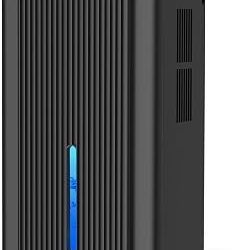
PuroAir 240
The CarbonTech bed is the reason this one belongs in a smoking room — it’s a substantial granular layer rather than a coated screen, and it holds up against gas-phase odor far longer than the price suggests. Generous airflow for its footprint makes it a sensible pick for a furnished sunroom or a bedroom that shares air with a porch.
Dreo 338 HEPA Purifier
AHAM-verified performance plus an onboard PM2.5 readout means you can watch the room recover in real time, which is genuinely useful for dialing in placement near a slider or screen door. Turbo clears a smoke event quickly, and the sleep mode is quiet enough to leave running in a guest room.
PuroAir 240 (2-Pack)
Two mid-size units almost always beat one large one in indoor-outdoor layouts, because open-plan porches and adjoining rooms don’t share air evenly. Stage one near the smoking area and one at the interior threshold and you intercept drift instead of diluting it after the fact.
LEVOIT Core 300 / Core 300-P
Still the most sensible small-room buy on the market: H13 media, a genuinely low noise floor, and a compact cylinder that disappears beside a chair or console. Filters saturate faster in heavy smoke, so budget for a shorter change interval than the manual’s baseline.
AirDoctor AD3500
The most capable unit here for large or awkward volumes, with UltraHEPA media and a deep carbon-VOC stage that handles stale, set-in smoke odor rather than merely masking it. Worth the premium in a great room, converted garage, or wide covered patio enclosure.
Frequently Asked Questions
Will a purifier remove cigarette smell entirely?
It removes what’s airborne. Odor already absorbed into cushions, rugs, and drapery keeps re-releasing, so pair filtration with washable slipcovers and periodic textile cleaning for a lasting result.
Where should I position the unit?
Between the smoke source and the rest of the house, roughly a foot off walls, with clear intake and exhaust. On a screened porch, place it upwind of the interior door so it catches air before it migrates in.
How often do filters need changing with smoke?
Expect roughly half the rated lifespan. Carbon exhausts before HEPA does, and returning odor is your signal — smell is the honest indicator here, not the calendar.
Are ionizers or ozone generators better for smoke?
No. Ozone is a respiratory irritant and doesn’t reliably eliminate smoke compounds. Stick with mechanical filtration plus adsorptive carbon.
Final Thoughts
For most furnished porches, sunrooms, and bedrooms bordering a smoking area, the PuroAir 240 delivers the best carbon capacity per dollar, and the two-pack is the smarter buy anywhere air moves between zones. Step up to the AirDoctor AD3500 for large open volumes with entrenched odor, or choose the LEVOIT Core 300 when you need quiet, unobtrusive coverage in a single small room.