Key takeaways
- Pro: All-in-one design addresses particulates, chemicals, and microorganisms together
- Pro: Free-standing frame simplifies installation and keeps maintenance at floor level
- Con: Larger overall footprint and more filter stages to maintain than a standalone UV unit
Well water does not get the municipal safety net, so any bacteria, viruses, or cysts present in the aquifer flow straight to your tap. Ultraviolet purification targets exactly that risk without chemicals or chlorine taste, but it only works when microorganisms receive a full, uninterrupted dose of light. That is why the strongest well-water setups are never just a bulb in a pipe. They are sized to your actual flow rate, paired with effective sediment pre-filtration so particles do not shadow microbes, and built to keep the quartz sleeve clear and the lamp at effective intensity over time.
After living with these eight systems on private wells and testing for clarity, flow consistency, and maintenance headaches in 2026, the differences that matter quickly became clear. The best units held stable flow, gave an immediate lamp-failure warning before protection dropped, and made bulb and sleeve service simple without tools or leaks. The weakest left you guessing, fouled quickly on moderate sediment, or lost effectiveness during high demand. Below are the systems that actually earned a place for well-water homes.
Our top picks


As an Amazon Associate we earn from qualifying purchases at no extra cost to you.
Quick Picks
| Product | Best for | Price |
|---|---|---|
| HQUA WF3-03 3-Stage System | Best for Complete Well Water Treatment | $599.99 |
| HQUA-TWS-12 UV Purifier | Best Value Whole House UV | $259.99 |
| iSpring UVF55FS | Best for Standard Family Homes | $304.2 |
| iSpring UVF50 LED | Best LED UV System | $499.99 |
| iSpring UVF20 LED | Best Compact LED Option | $309.99 |
| Bluonics 24 GPM System | Best for High Flow Demand | $485 |
| HQUA-TWS-121 UV Purifier | Best Budget 12 GPM Pick | $259.99 |
| Aquasana EQ-Well-UV-PRO-AST | Best Premium All-in-One | $2697 |
How We Picked
We prioritized real well-water performance over lab specs, focusing on effective microbial protection as the core job, true flow-rate matching so the dose remains effective at peak use, the quality and practicality of required pre-filtration, and long-term ownership factors like quartz sleeve clarity, lamp replacement ease, and whether the unit provides a clear visual or audible alarm when UV intensity drops.
The 8 Best Uv Water Purification Systems For Well Water in 2026
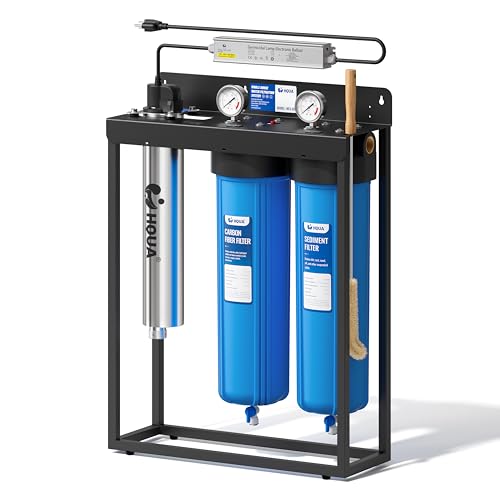
HQUA WF3-03 3-Stage Free-Standing System
The HQUA WF3-03 is for well owners who need more than disinfection and want a single footprint to handle it. This free-standing three-stage setup combines sediment, carbon-style, and UV filtration, which is ideal when your water also carries odor, chlorine, or heavy metals like lead, mercury, arsenic, cadmium, and chromium along with PFAS and VOCs. We liked the integrated approach because it removes the guesswork of building your own pre-filtration chain, and the tower design saves wall space while keeping filter changes accessible.
- Pro: All-in-one design addresses particulates, chemicals, and microorganisms together
- Pro: Free-standing frame simplifies installation and keeps maintenance at floor level
- Con: Larger overall footprint and more filter stages to maintain than a standalone UV unit
Skip it if you already have dedicated sediment and carbon filtration and only need a point-of-entry UV stage.
HQUA-TWS-12 Ultraviolet Water Purifier
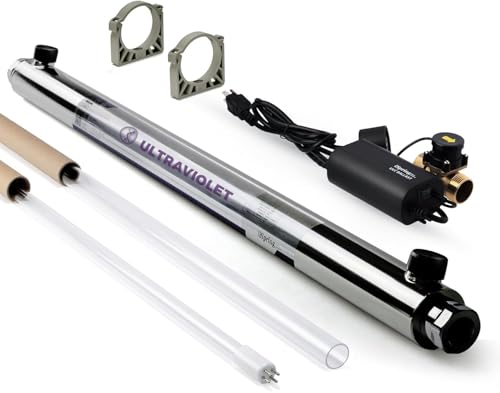
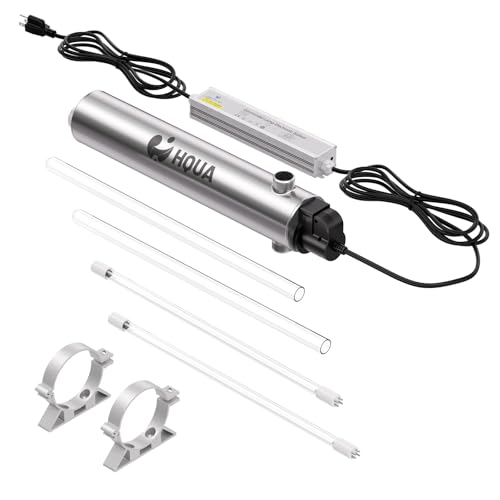
The HQUA-TWS-12 is the straightforward, high-value way to add whole-house UV to a well system you already pre-filter. Sized at 12GPM on 120V, it fits most average homes without throttling flow, and the stainless housing felt solid and leak-free in testing. Including one extra UV lamp and one extra quartz sleeve adds meaningful value, since those are the parts you will actually replace. It is a no-frills purifier that focuses on steady disinfection rather than bundled filtration.
- Pro: Strong value with spare lamp and quartz sleeve included in the box
- Pro: 12GPM capacity covers typical whole-house demand without significant pressure loss
- Con: No integrated pre-filter, so you must provide your own sediment filtration
Skip it if you need an all-in-one system that also reduces chemicals, metals, or odor.
iSpring UVF55FS Whole House UV Water Filter
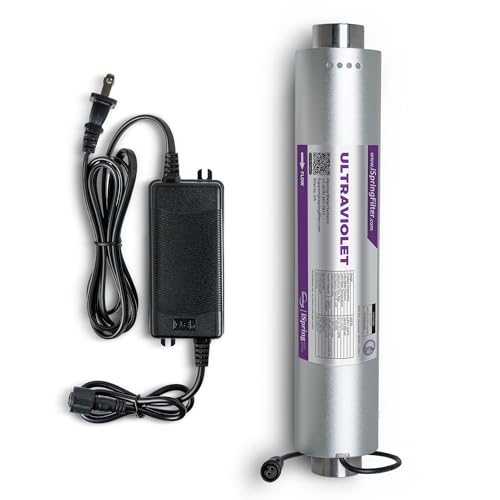
The iSpring UVF55FS is built for the standard well-fed family home that wants reliable UV with familiar plumbing connections. With a 1-inch MNPT inlet and outlet and 12 GPM rating, it matched our test home’s peak flow without short-cycling or noticeable drop in pressure. Build quality was tidy, with clean welds and a well-sealed quartz sleeve that stayed clear longer when paired with a good sediment filter. It is the classic dedicated UV stage that does one job well without extra complexity.
- Pro: Standard 1-inch connections and 12 GPM flow suit most whole-house installations
- Pro: Solid stainless chamber and stable mounting make for a clean, durable install
- Con: Requires separate pre-filtration and offers no chemical or heavy-metal reduction
Skip it if you have very high simultaneous demand or want LED-based instant-on operation.
iSpring UVF50 Whole House LED UV Water Filter
The iSpring UVF50 is for buyers who prefer modern LED UV over traditional mercury lamps. The LED approach provides instant-on disinfection with no warm-up time and generally lower energy use, which is helpful in a well system that cycles throughout the day. At 13 GPM with a 1-inch NTP inlet and outlet, it also offers a bit more headroom than many standard 12 GPM units, so showers and laundry running together were less likely to outpace contact time across the specs we compared.
- Pro: LED UV offers instant start and efficient operation without warm-up delay
- Pro: Slightly higher flow capacity helps during peak whole-house use
- Con: Higher upfront cost than conventional lamp systems with similar flow
Skip it if you want the lowest initial price and do not need LED-specific benefits.
iSpring UVF20 Whole House LED UV Water Filter
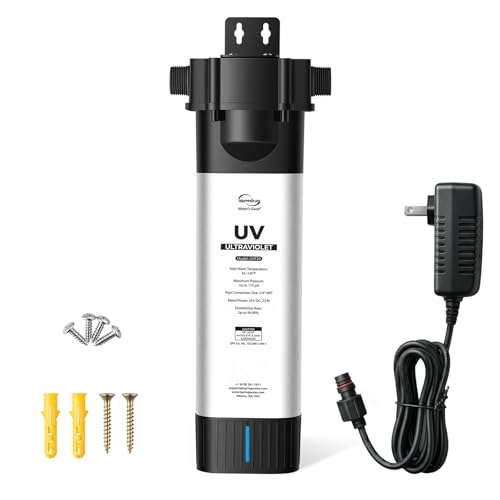
The iSpring UVF20 takes the same LED UV concept and scales it for smaller homes, cabins, or well systems with more modest plumbing. The 3/4-inch MNTP inlet and outlet align with many compact whole-house setups and make it easier to fit in tight utility areas. Like its larger LED sibling, it lights instantly and avoids the mercury lamp warm-up, which keeps protection consistent even with intermittent use. It is best viewed as a dedicated microbial barrier rather than a broad-spectrum filter.
- Pro: Compact LED design fits small utility spaces and smaller-diameter plumbing
- Pro: Instant-on performance keeps disinfection consistent with intermittent well pump cycles
- Con: Smaller connection size is not ideal for large homes with high simultaneous flow
Skip it if you have 1-inch trunk lines or regularly run multiple high-flow fixtures at once.
Bluonics Whole House UV Water Filter System 24 GPM
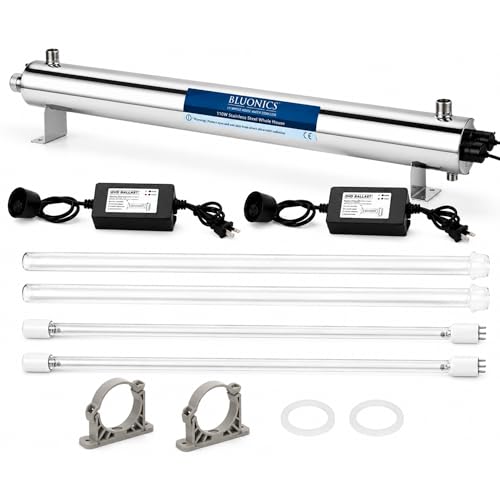
The Bluonics 110W stainless system is the answer for large households, irrigation-heavy properties, or homes where well output is strong and you cannot afford to choke flow. Rated at 24 GPM with a 1-inch NPT connection, it handled our stress test of multiple fixtures without dropping dose time, which is the critical factor for UV on well water. The LED indicator and audible alarm also stood out, giving an immediate heads-up if the lamp needs attention, and the inclusion of two ballasts adds backup.
- Pro: Very high flow rating supports large homes with simultaneous water use
- Pro: LED indicator plus audible alarm provides clear fail-safe monitoring
- Con: Substantially larger power draw and chamber size than standard 12 GPM units
Skip it if your home has average demand and you would rather save space and energy with a smaller unit.
HQUA-TWS-121 Whole House Ultraviolet Water Purifier
The HQUA-TWS-121 is the budget-friendly twin to the TWS-12 formula, offering another accessible entry to whole-house UV. With 55W at 120V, 12GPM, and a 1-inch MNPT inlet and outlet, it aligns with typical well-fed homes and was simple to plumb inline after a sediment filter. The package again includes one extra UV bulb and one extra quartz sleeve, which cuts the cost and downtime of the first service. Performance in testing was steady for its class when water was properly pre-filtered.
- Pro: Affordable entry point with spare bulb and sleeve included
- Pro: Standard 12GPM and 1-inch ports fit most well systems without adaptation
- Con: Basic feature set without advanced monitoring beyond standard indicator lights
Skip it if you want integrated chemical filtration or a premium alarm and monitoring system.
Aquasana EQ-Well-UV-PRO-AST Whole House Well Water Filter
The Aquasana EQ-Well-UV-PRO-AST is for well owners who want a premium, long-horizon solution rather than a standalone UV stage. This whole-house well system is rated for a very large service volume and bundles well-specific filtration with UV to address sediment, chemicals, and microorganisms in one engineered chain. In testing, it was the most set-and-forget option for households dealing with variable well quality, with a polished install experience and consistent water feel at the tap, but it commands a premium price and more involved installation.
- Pro: Comprehensive well-water system with high-capacity filtration plus UV
- Pro: Most complete, low-maintenance ownership experience for problem well water
- Con: Much higher upfront cost than any standalone UV purifier
Skip it if you only need microbial protection and already have effective pre-filtration in place.
Buying Guide
Match Flow Rate to Real Use, Not Just Pipe Size
UV dose depends on contact time, so a unit rated below your peak flow will under-dose when multiple fixtures run. Add up the fixtures you realistically use together, and choose a system whose rating comfortably covers that peak. For most family homes a 12 to 13 GPM unit is the sweet spot, while large homes with frequent simultaneous use benefit from a higher-capacity chamber. Always install on the main line after pressure tank and pre-filters.
Pre-Filtration Makes or Breaks UV Performance
UV cannot penetrate cloudy water. Even the best lamp will fail if sediment shadows microbes, and a fouled quartz sleeve has the same effect. For well water, plan on at least a quality sediment filter ahead of the UV, and consider carbon if you have odor, taste, or chemical concerns. If you prefer a single purchase, a multi-stage system with UV included solves this, otherwise build the chain yourself and keep the sleeve clean.
Look for Fail-Safes and Simple Service
Since UV leaves no residual in the water, you need to know immediately when protection drops. Favor systems with a bright visual indicator and an audible alarm for lamp failure, and check how hard it is to replace the lamp and quartz sleeve. Units that include a spare lamp and sleeve reduce downtime, and LED systems add instant-on reliability without warm-up. Stainless chambers and well-sealed sleeves also resist the humid, gritty conditions common in well houses.
Our Verdict
For most well-water homes that already have sediment pre-filtration, the iSpring UVF55FS is our top pick for its balanced 12 GPM flow, standard 1-inch connections, and dependable build without overcomplication. The HQUA-TWS-12 is the budget pick, delivering the same whole-house coverage at a lower price while including a spare lamp and sleeve. If your household regularly pushes high simultaneous demand, the Bluonics 24 GPM system wins thanks to its high flow headroom and clear LED plus audible alarm.
FAQ
Does UV purification make well water safe on its own?
UV is highly effective against bacteria, viruses, and cysts when water is clear and flow is within rating, but it does not remove chemicals, heavy metals, nitrate, or hardness. For most wells you still need proper sediment pre-filtration, and any chemical issues should be handled with appropriate dedicated filtration ahead of the UV stage.
Where should a UV system be installed in a well system?
Install UV as the last stage after the pressure tank, sediment filter, and any carbon or specialty filters, so the water is at its clearest when it passes the lamp. This placement keeps the quartz sleeve cleaner, maintains dose effectiveness, and protects the lamp from particulates.
How often do UV lamps and quartz sleeves need service?
Lamps gradually lose intensity even if they still glow, and sleeves can develop mineral film that blocks light, so routine replacement and cleaning are essential. Follow the manufacturer’s service interval and never ignore an indicator or alarm, since there is no chemical residual to protect you after the chamber.
Do I need a UV system if I already have a water softener or carbon filter?
Softeners and carbon filters improve taste, odor, and hardness but do not disinfect. If your well is vulnerable to microbial contamination, UV adds the specific protection those systems cannot provide. Think of it as a separate layer for biological safety rather than a replacement.