Key takeaways
- Compare fixed partitions and movable screens by purpose, changeability, complete project scope and realistic privacy expectations before committing.
What's inside
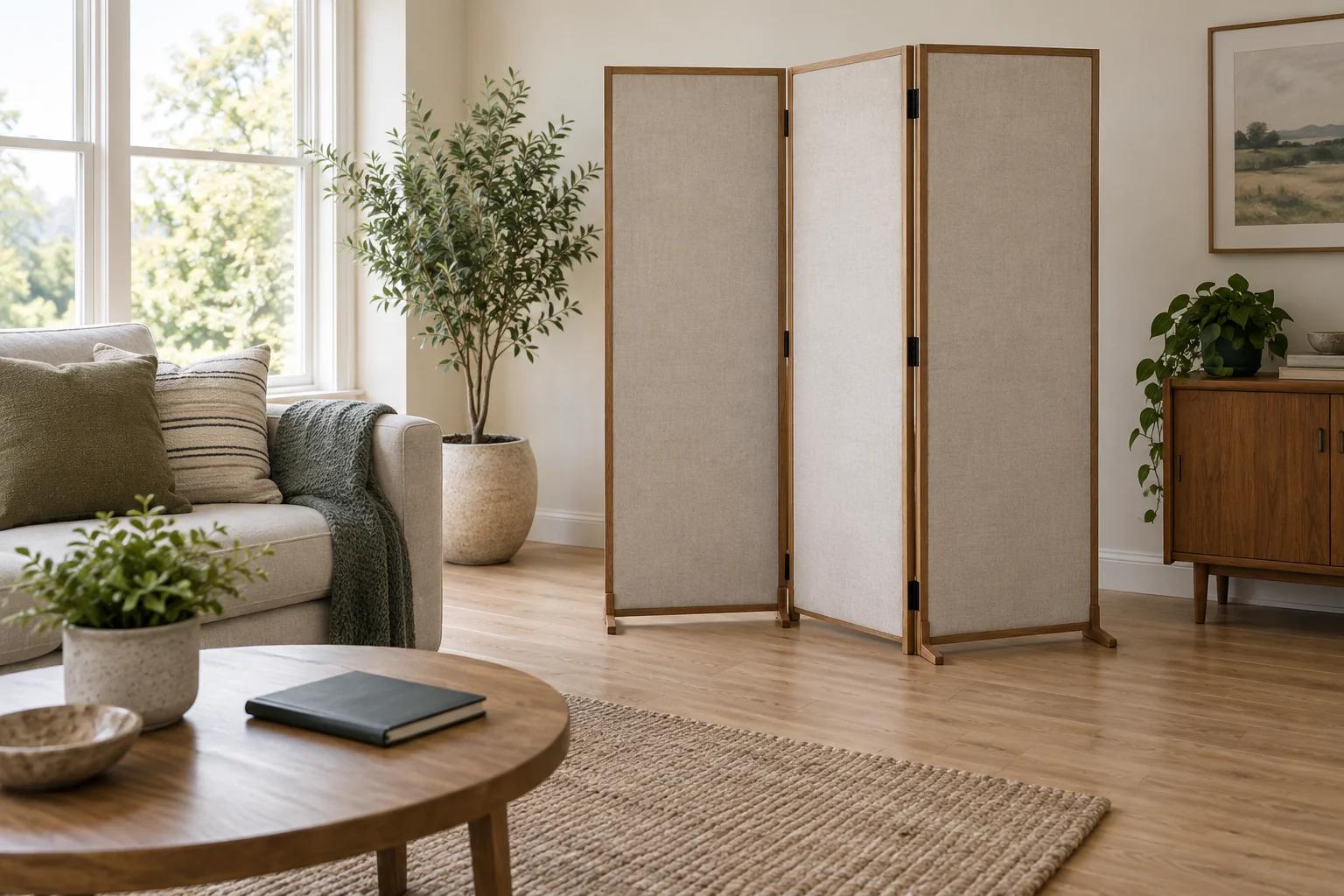
Compare a permanent partition with a movable screen by asking how long the separation must last, what it must actually do and how the room may need to change later. A screen is a furniture decision; a fixed partition can become a building project. Their prices alone do not describe the difference.
Write one sentence explaining the desired result before requesting quotes. “Hide the desk from the sofa after work” is a different brief from “create an enclosed room for confidential conversations.” The first may be a visual problem. The second requires a much broader assessment than choosing a tall panel.
Define the boundary you need
List what must cross the proposed boundary: people, daylight, air, cables and sound. Then list what you want it to interrupt. This prevents the word “privacy” from hiding several unrelated expectations. A person may want a screen to conceal stored supplies without wanting to reduce light or create a closed room.
IKEA’s room-divider guidance emphasizes visual separation and reduced visual distraction. That supports treating a screen as a possible sightline tool. It does not establish that any particular divider creates a legally separate room or provides confidential speech privacy.
Keep the exact product’s instructions available when evaluating movable options. “Freestanding” and “movable” should come from the product’s design, not from removing required wall attachments from an ordinary cabinet. A piece that needs anchoring cannot simply be reassigned as a loose partition.
Compare what happens when the plan changes
| Decision | Movable screen question | Permanent partition question |
|---|---|---|
| Duration | Can it be put away when separation is unnecessary? | Will the fixed arrangement remain useful? |
| Space | Where do its supports and folded form go? | What usable area and opening does the completed project leave? |
| Responsibility | Who moves, stores and maintains it? | Who designs, approves and carries out the work? |
| Future change | Can the product suit another position? | What removal and making-good work would be needed? |
| Evidence | Which product claims apply to this model? | Which project specifications support the required result? |
A screen that folds small can still be inconvenient if nobody has a place to store it. Conversely, a fixed partition may be useful for a stable long-term arrangement but poorly suited to a room that changes function every weekend. Include the change itself in the comparison rather than judging only the finished photograph.
Ask about permissions before comparing final costs
For a fixed proposal, identify who must confirm that the work is acceptable for the property and location. That may involve the owner or building manager and the relevant qualified professionals or local authority. Ask them to identify the applicable requirements; do not assume that a non-load-bearing description makes a project exempt from review.
Record unresolved questions about the proposed opening, services and the room’s intended use. You do not need to solve those technical matters in a furniture-shopping worksheet. You do need to know which answers are still missing before treating a construction quote as a complete alternative.
Compare like-for-like responsibilities
Put the full screen arrangement on one side: product, delivery, assembly where needed, required accessories and a workable storage place. On the partition side, ask the contractor what the price includes and excludes, including design, relevant approvals, finishes, affected services and cleanup. Use actual quotes; there is no useful universal cost ratio between these options.
Also record disruption. Which room functions will be unavailable during the work, and what temporary arrangement will the household use? For a screen, the comparable question is the recurring effort of setting it up and putting it away. Small daily tasks can matter more than a one-time purchase difference.
Keep acoustic expectations specific
USG’s acoustical assemblies guidance distinguishes sound control within a space from control between spaces and explains that sound can travel around barriers and through openings. Accordingly, ask for evidence relevant to the whole proposed arrangement rather than interpreting an absorbing material as a promise of isolation.
If speech privacy is essential, state that requirement to an appropriate professional. Do not use a product’s soft surface, panel thickness or attractive room photograph as a substitute for a supported design. Equally, do not assume that any new wall automatically delivers the result you want.
A fictional decision with a clear endpoint
Imagine a household wanting to hide a desk during weekend meals while retaining one open room on other days. Their comparison favors a suitable movable screen because the boundary is temporary and visual. They still need a stable permitted setup and a storage destination. A permanent wall offers no useful advantage for that particular brief.
Another household may need a fixed enclosed space for a lasting use. Its next step is a project assessment, not simply buying a larger screen. Keep the two decisions separate. If you have not yet identified the conflicting activities, start with the shared living-room activity plan before committing to either option.