Teak is forgiving right up until someone tries too hard. The table that weathers to silver-gray and gets a wash once a year will still be sound in 30 years. The table that gets pressure-washed, sanded with coarse paper, and coated in teak oil every spring often looks worse by year five: fuzzy raised grain from the pressure washer, black mildew feeding on the oil, and a blotchy finish where the oil went on unevenly. The other failure mode is applying a film-forming varnish, which peels in sheets after two seasons and has to be stripped. Good teak maintenance is mostly about cleaning gently and then deciding once, deliberately, whether you want honey-brown or silver-gray, because each path has a different routine.
What You Need
| Item | Why | Optional? |
|---|---|---|
| Soft-bristle brush and bucket | Cleaning without raising the grain | No |
| Mild dish soap or a two-part teak cleaner | Soap for routine cleaning; the two-part cleaner (cleaner plus brightener) for restoring gray wood to brown | No, one or the other |
| Garden hose with spray nozzle | Rinsing; never a pressure washer | No |
| 120- to 220-grit sandpaper and a sanding block | Smoothing raised grain and removing stains; 220 for the final pass | Yes |
| Teak sealer (not teak oil) or nothing | Sealer holds the honey color 12 months or more and resists mildew far better than oil | Yes, if keeping the brown color |
| Lint-free rags and a foam brush | Applying sealer evenly | Yes |
| Rubber gloves, eye protection | Two-part cleaners are acidic and caustic | No, if using them |
| Breathable furniture cover | Keeps debris and bird droppings off without trapping moisture | Yes |
| Wood glue and stainless screws | Tightening joints that loosen with seasonal movement | Yes |
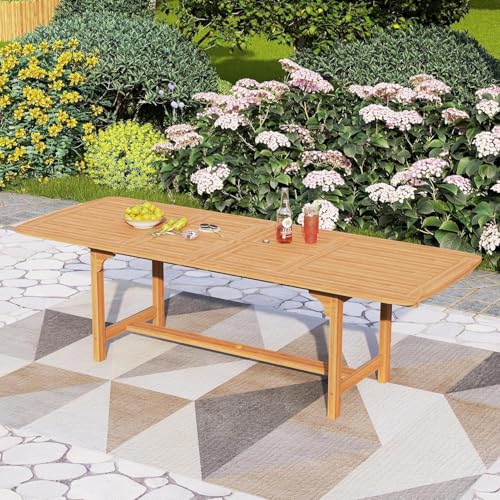
The tables this applies to are worth protecting. A solid PHI VILLA Teak Outdoor Table, an expandable wood table with umbrella hole, lists at $457.99; a full Amazonia Franklin 9-Piece Rectangular Extendable Patio Dining Set in teak finish with Weather-Net technology lists at $1,597. Note the words “teak finish” on some sets: that usually means eucalyptus or another hardwood stained to look like teak, and it needs sealing every year rather than the optional care genuine teak gets.
Our top picks
 Amazonia Franklin 9-Piece Rectangular Extendable Patio Dining
- [9-PIECE SET] This set includes 8 armchairs and…
- [FREE Amazonia Maintenance Kit] For longest strap durability
- [DIMENSIONS] Extendable Rectangular Table: 118L x 42W x…
As an Amazon Associate we earn from qualifying purchases at no extra cost to you.
Step-by-Step
1. Clear and inspect (5 minutes)
Remove the umbrella, cushions, and anything on the table. Look for loose joints, lifted end grain, black mildew spots, and water rings. Check the underside and where the legs meet the ground; that is where moisture sits and where problems start.
2. Routine wash (15 to 20 minutes)
Mix 2 tablespoons of dish soap in a gallon of warm water. Scrub with the soft brush along the grain, top and underside, then rinse with the hose. For a table you are keeping gray, this is the whole cleaning routine; let it dry and skip to step 7.
3. Restore gray teak to brown, if desired (30 to 45 minutes)
Wet the table. Apply part one of a two-part teak cleaner with a brush, let it work 5 to 10 minutes as the gray lifts, scrub lightly along the grain, and rinse. Apply part two (the brightener) the same way; it neutralizes the cleaner and pulls out the honey color. Rinse thoroughly. The wood will look darker wet and lighten as it dries.
4. Dry fully (24 to 48 hours)
Let the table dry in shade or sun for a full day, two if humidity is high. Sealer applied to damp teak turns cloudy and peels.
5. Sand lightly (20 to 30 minutes)
Once dry, sand any raised grain, water rings, or stubborn stains with 120-grit along the grain, then finish the whole top with 220-grit. Keep the block flat on the surface. Wipe off dust with a dry cloth, then with a rag barely dampened with water.
6. Seal, if keeping the color (30 minutes plus curing)
Apply teak sealer, not oil, in a thin, even coat with a foam brush or rag, working along the grain. Wipe off any excess within 10 to 15 minutes so it does not leave shiny patches. One coat is typical; a second after 4 to 6 hours on a very thirsty table. Keep it dry for 24 hours.
7. Tighten hardware and glue loose joints (10 minutes)
Snug any bolts or screws a quarter turn; do not overtighten into the wood. A loose tenon can be worked with waterproof wood glue and clamped overnight. Replace any rusted fasteners with stainless.
8. Protect (5 minutes)
Set the table on its feet on a dry surface, add felt or rubber pads under the legs if they sit on pavers that hold water, and use a breathable cover when the table will sit unused for more than a few days.
Mistakes to Avoid
- Pressure washing. Even at 1,200 PSI it raises the grain into a fuzzy surface that traps dirt and looks worse each season.
- Teak oil outdoors. It feeds mildew, darkens unevenly, and needs reapplication every 2 to 3 months. Use sealer or nothing.
- Varnish or polyurethane. Film finishes crack and peel on teak because the wood moves and its oils resist adhesion; stripping is a weekend of work.
- Coarse sandpaper. Anything under 100-grit leaves scratches you will see when the wood darkens after rain.
- Sealing damp wood. The finish clouds and lifts. Wait a full day after washing.
- Bleach for mildew. It works but leaves the wood pale and uneven; the two-part cleaner handles mildew and color together.
- Non-breathable plastic covers. They trap condensation against the wood and grow mildew underneath.
How Often
Wash with soap and water two to four times a season, more if the table sits under trees or gets heavy use. Sand and reseal once a year if you are keeping the honey color; most sealers hold 9 to 12 months in full sun. If you prefer gray, you never sand or seal, just wash. Tighten hardware each spring. Do a two-part restoration only when you want to bring gray wood back to brown, typically once every few years or once at purchase if the table arrived gray. Handle food stains, especially oil and red wine, within a day with soap and a light sand. In 2026, a well-made teak table kept on this routine is a 30- to 50-year piece; a stained eucalyptus “teak finish” table needs the seal-every-year routine to reach 10.
When to Call a Pro or Replace
A furniture refinisher, roughly $150 to $400 for a 6-seat table, is worth it when a previous owner applied varnish or paint that needs stripping, when deep black staining has penetrated past what 120-grit sanding reaches, or when the table is a heavy 100-plus-pound piece you cannot flip and sand yourself. Structural repairs to a cracked apron or a split leg tenon are also refinisher or woodworker territory at $75 to $200 per joint. Replace the table when the top boards have cupped more than 1/4 inch and no longer sit flat, when checking has opened into cracks that go through the board, or when the joinery has loosened so much that glue and clamps will not hold; at that point the wood has served its life, and a replacement of the same quality will run $450 to $2,500.
FAQ
Should I oil my teak outdoor table?
No, not outdoors. Teak oil feeds mildew and needs reapplying every 2 to 3 months. Leave the wood bare to gray naturally, or use a teak sealer, which holds the honey color for about a year and resists mildew.
How do I bring gray teak back to its original color?
Use a two-part teak cleaner: the cleaner lifts the gray oxidized layer, the brightener neutralizes it and restores the honey tone. Rinse, let dry 24 to 48 hours, sand lightly with 220-grit, and seal if you want the color to last.
Can I leave a teak dining table outside all year?
Yes. Teak tolerates rain, snow, and freeze-thaw cycles. Use a breathable cover in the off-season to keep debris off, lift the legs off standing water with pads, and remove cushions.
How do I remove water rings and food stains from teak?
Wash with soap and water first. If the mark remains, sand along the grain with 120-grit until it disappears, finish with 220-grit, and reseal the spot or the whole top so the sanded area matches after the next rain.