Our Top Picks
 Fosi Audio BT10A Bluetooth 5.0 Stereo Audio Amplifier4.6 x 3.7 x 1.4 Inches1.4 poundsCheck on Amazon
Best Hi Fi Amplifier Deals: How to Match Watts, Inputs and Shelf Space Before You Buy
The best hi fi amplifier deals are the ones where the power rating actually matches your speakers, the input panel covers what you own, and the chassis physically fits where you intend to put it — because a 40% discount on a 50 W amplifier driving 84 dB speakers in a 12×14 ft room is not a deal, it’s a return label waiting to happen. In 2026 the amplifier market is unusually favorable to buyers: Class D modules from Hypex, Purifi and ICEpower have pushed credible 100 W-per-channel integrated amps into the $400–$900 band, while the vinyl revival has forced even budget models to include a decent moving-magnet phono stage, and HDMI ARC has trickled down from AV receivers into stereo integrateds. That combination means the deal you want is rarely the cheapest listing — it is the one whose spec sheet lines up with the load it will drive and the shelf it will sit on.
This guide works through the decision in the order it actually matters: power versus speaker sensitivity and impedance first, because that determines whether an amplifier will sound dynamic or strained; inputs second, because a missing phono stage or HDMI port costs more to fix later than to buy up front; and physical realities third — shelf depth, rear-panel clearance, ventilation gaps, and what these boxes weigh when you have to move one. Everything is described by type and specification, with general market ranges rather than specific listings.
Fosi Audio BT10A Bluetooth 5.0 Stereo Audio Amplifier Receiver 2 Channel Class D Mini Hi-Fi Integrated Amp for Home Passive Speakers 50W x 2 TPA3116
Picked as a relevant option in this category.
View on Amazon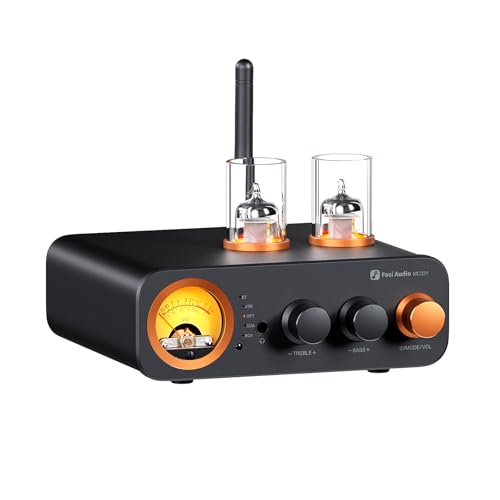
Fosi Audio MC331 Tube Integrated Amplifier with DAC, 2 Channel Home Audio Stereo Power Amp for HiFi Bookshelf Speakers/3.5mm Headphones, Vintage VU Meter Preamp with Bluetooth and USB/Opt/Coax/RCA
Chosen because it specifies Vintage VU Meter Preamp with Bluetooth and USB/Opt/Coax/RCA.
View on Amazon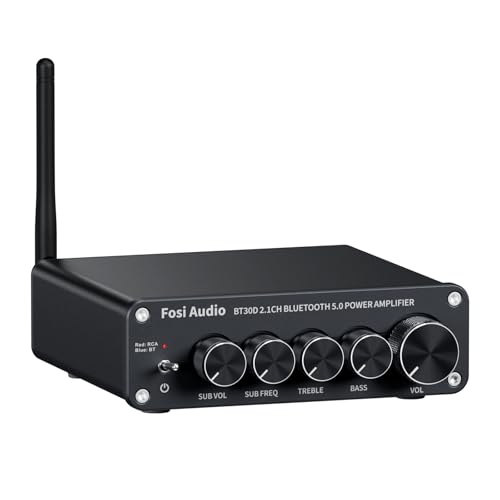
Fosi Audio BT30D Bluetooth 5.0 Stereo Audio Receiver Amplifier 2.1 Channel Mini Hi-Fi Class D Integrated Amp 50 Watt x2+100 Watt for Home Outdoor Passive Speakers/Subwoofer Powered Subwoofer
Picked as a relevant option in this category.
View on Amazon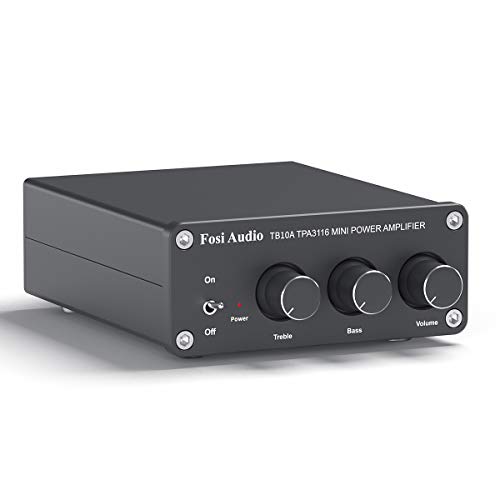
Fosi Audio TB10A 2 Channel Stereo Audio Amplifier Receiver Mini Hi-Fi Class D Integrated Amp 2.0CH for Home Speakers 100W x 2 with Bass and Treble Control TPA3116(with Power Supply)
Picked as a relevant option in this category.
View on AmazonStart With the Load: Sensitivity, Impedance and Real Power Needs
Amplifier power ratings are quoted into 8 ohms, but most affordable bookshelf and floorstanding speakers in 2026 are nominally 4 to 6 ohms, and their impedance swings far below the nominal figure at low frequencies. A speaker rated “8 ohms nominal” may dip to 4.5 ohms around 120 Hz. That dip is where an underpowered amplifier clips, and clipping is what actually damages tweeters — not “too much power.” So the matching exercise is not about avoiding big numbers; it is about buying enough headroom that the amplifier never has to clip at your realistic listening level.
The sensitivity math that predicts whether 50 W is enough
Speaker sensitivity tells you how loud a speaker plays for 1 watt at 1 metre. Every 3 dB increase in loudness requires double the power. A rough working table for a typical listening distance of 2.5–3 m (8–10 ft) in a room with normal furnishings looks like this:
| Speaker sensitivity | Power for ~85 dB avg (moderate) | Power for ~95 dB peaks (lively) | Power for ~105 dB peaks (party) | Amplifier class to target |
|---|---|---|---|---|
| 84 dB/2.83 V/1 m (hard to drive) | 25–40 W | 150–200 W | 400 W+ (or bi-amp) | High-current Class AB, 100 W+ into 4Ω |
| 86–87 dB (common small bookshelf) | 15–25 W | 90–120 W | 250–300 W | 80–120 W Class D or AB |
| 88–89 dB (typical standmount) | 10–20 W | 60–80 W | 150–200 W | 50–100 W, any class |
| 90–91 dB (efficient floorstander) | 5–15 W | 30–50 W | 80–120 W | 35–60 W, tube or Class D |
| 93 dB+ (horn, high-efficiency) | 2–8 W | 15–25 W | 40–60 W | 8–25 W single-ended or push-pull tube |
Note the jump from the first column to the second. If you listen at moderate levels in a small room, a 50 W amp into 88 dB speakers is comfortable. If you want headroom for orchestral crescendos or bass-heavy material, you need 4x the power just to gain 6 dB. This is why “100 W per channel” is not marketing fluff for most buyers in a normal room — it is simply the honest number for peaks.
Impedance: what the spec sheet hides
Two figures matter, and budget amps often publish only the first: power into 8 ohms, and power into 4 ohms. If a manufacturer quotes 50 W into 8 ohms and only 60 W into 4 ohms, the amplifier’s power supply is current-limited — it cannot double output as load impedance halves. A well-built amp rated 50 W into 8 ohms typically delivers 80–100 W into 4 ohms. If you own 4-ohm speakers or speakers with a nasty minimum-impedance dip, prioritise amplifiers advertised as “high current” or those that publish a clean 4-ohm rating at least 1.6x the 8-ohm figure.
- 4-ohm nominal speakers: insist on a published 4-ohm power rating and a minimum-impedance claim. Without both, assume the amp will run hot and compress.
- 6-ohm with a 4.8-ohm dip: a 70–100 W Class D integrated handles this comfortably; a 30 W tube amp may not.
- 8-ohm bookshelf, 87 dB: almost any 40–60 W amp works; spend the saved money on a phono stage instead.
- Two pairs of speakers (A+B): paralleling two 8-ohm pairs gives 4 ohms; two 4-ohm pairs gives 2 ohms, which most integrateds cannot drive at all. Check for a speaker-selector switch that keeps impedance safe.
Inputs: Phono, HDMI ARC, Optical and the Ports People Forget
The input panel is where most “good deal” amplifiers quietly fail. Buyers who later add a turntable, a TV or a streamer often discover the cheap integrated they bought has two line-level RCA inputs and nothing else — and a standalone phono preamp plus an HDMI audio extractor plus cables can add $150–$350, wiping out the discount entirely.
Phono stages: moving magnet, moving coil, and loading
A built-in phono stage labelled “MM” handles the majority of cartridges — moving magnet and the higher-output moving coil designs. Genuine low-output moving coil cartridges (typically 0.2–0.5 mV output) need either a dedicated MC stage with selectable loading (usually 100 ohms) or a step-up transformer. If a spec sheet says only “Phono (MM)” you can safely assume MC is not supported.
Two details separate a decent built-in phono input from a placeholder: adjustable input capacitance (100 pF and 220 pF are common) and a published gain figure (typically 38–42 dB for MM). Fixed, unlabelled phono stages are the ones that sound thin and bright with many cartridges, because the input capacitance is a mismatch. If you are serious about vinyl, a $120–$250 standalone phono preamp into a plain line input will outperform most built-in stages at the budget end, and it is upgradeable — the built-in never is.
HDMI ARC vs optical: getting TV sound into a stereo amplifier
HDMI ARC (Audio Return Channel) lets a TV send audio to the amplifier over a single HDMI cable and lets the TV remote control volume over CEC. It has become common on mid-range stereo integrateds in 2026, but it is still absent from many entry-level models. Optical (TOSLINK) is the universal fallback and works with virtually every TV, but it cannot carry the lossless multichannel formats and it does not support CEC volume control, so you may juggle two remotes. Coaxial S/PDIF is functionally similar to optical for stereo and often present alongside it.
| Connection | Carries | CEC volume control | Typical presence in 2026 | Best for |
|---|---|---|---|---|
| HDMI ARC / eARC | Stereo + multichannel PCM, lossless formats (eARC) | Yes | Mid-range and up | One-remote TV listening |
| Optical TOSLINK | Stereo PCM, Dolby/DTS bitstream | No | Nearly universal | Older TVs, consoles, cheap universal fit |
| Coaxial S/PDIF | Stereo PCM, bitstream | No | Common | CD transports, streamers |
| USB-B (asynchronous) | PCM up to high sample rates | No | Common on desktop-oriented units | Computer audio |
| USB-A (mass storage) | Files from a stick or drive | No | Declining | Standalone playback without a PC |
| Bluetooth (aptX / AAC / LDAC) | Compressed wireless audio | N/A | Nearly universal | Casual phone listening; convenience only |
| Line-level RCA | Analogue stereo | No | Universal | CD players, tape decks, external DACs |
| Pre-out / sub-out | Signal to subwoofer or power amp | No | Common | Adding a sub, upgrading later |
One more input worth checking: a phono/line switchable input. Some amplifiers let a single RCA pair serve either purpose via a rear toggle. That is genuinely useful — it means a second turntable or a tape deck can share the same socket.
Shelf Depth, Height and Ventilation: The Measurements Nobody Publishes
Amplifiers fail thermally and fit physically before they fail electrically. Two hard numbers can save a purchase: rear-panel depth plus cable bend radius, and clear space above the top panel.
Real cabinet dimensions
A typical full-width stereo integrated amplifier is 430–440 mm wide (17 in) and 300–370 mm deep including rear connectors and speaker binding posts, which protrude 30–50 mm beyond the chassis. Allow a further 50–75 mm behind the rear panel for RCA plug bodies and speaker cable spades, because a right-angle bend is not always possible on stiff cable.
- Standard hi-fi rack (450 mm internal depth): fits most full-width integrateds with 40–80 mm to spare. Tight but workable.
- Bookcase or sideboard (300–350 mm internal depth): usually too shallow for a full-width amp once cables are attached. Slimline and half-width amplifiers (typically 250–280 mm deep) are the answer here.
- Open-top shelf with 200 mm between levels: fine for Class D, adequate for Class AB if the amp runs cool. Class A needs far more — often 300 mm+.
- Enclosed cabinet with a door: treat as a problem, not a placement. Even a cool-running amplifier inside a closed cabinet can raise internal temperatures by 8–15 °C.
Ventilation rules of thumb
Class D amplifiers are 80–95% efficient and typically run barely warm; a 20 mm gap above the case is often enough. Class AB integrateds convert 40–60% of input power to heat at idle-and-up, and manufacturers commonly specify a minimum of 100–150 mm of clearance above the top vents. Class A designs — rare but still sold — dissipate continuously and may specify 200–300 mm.
| Amplifier class | Typical idle heat | Manufacturer clearance spec (common) | Practical minimum in a real cabinet | Dominant failure mode when crowded |
|---|---|---|---|---|
| Class D | Very low (a few watts) | 20–50 mm | 25 mm above, 30 mm behind | Rare; usually fine in slim furniture |
| Class AB (integrated) | 20–60 W | 100–150 mm | 120 mm above, 60 mm behind | Electrolytic capacitor ageing, thermal shutdown |
| Class AB (high bias / “Class A-like”) | 80–150 W | 150–200 mm | 200 mm above, open front and back | Output device failure, solder fatigue |
| Tube (push-pull) | 60–120 W | Open top strongly preferred | Never enclosed | Tube life halved, transformer overheating |
| Tube (single-ended) | 100–200 W | Open, well-spaced | Never enclosed | Severe; not suitable for cabinetry at all |
Weight matters too, and it is a moving-day problem as much as a shelf problem. A 100 W Class AB integrated typically weighs 9–14 kg; a 2×50 W tube amplifier with transformers commonly runs 16–22 kg; a 100 W Class D integrated can be as light as 3–5 kg. If you are placing an amplifier on a glass shelf, check the shelf’s rated load — many decorative glass shelves are rated around 10 kg, which a mid-weight Class AB amp plus a turntable on the same shelf will exceed.
The Construction and Materials Trade-Off Behind Amplifier “Value”
Amplifier pricing is driven less by watts than by chassis, power supply and heat-sink materials, and the trade-offs are predictable. Knowing them explains why two 80 W amplifiers differ by $500.
| Element | Budget approach | Mid-range approach | What it changes in practice |
|---|---|---|---|
| Chassis | Folded steel, painted | Extruded aluminium front, steel body | Rigidity, resonance, scratch resistance, resale appearance |
| Heat sink | Small internal fins, relies on case vents | External finned extrusion | Continuous high-volume playback without thermal throttling |
| Power supply | Compact switch-mode, minimal capacitance | Larger switch-mode or toroidal transformer, more capacitance | 4-ohm drive capability, bass grip, dynamics on peaks |
| Volume control | Inexpensive potentiometer | Motorised pot or resistor-ladder/relay | Channel balance at low levels, remote control, longevity |
| Speaker terminals | Spring clips, thin plating | Binding posts accepting banana and spade | Cable compatibility, contact reliability over years |
| Internal connectors | Push-on spade tabs on boards | Soldered or screw-terminal connections | Resistance to vibration and thermal cycling |
| Capacitors | General-purpose electrolytics | 105 °C-rated, sometimes audio-grade | Service life; heat tolerance is the real variable |
Two practical conclusions follow. First, most of the audible difference between a $350 amplifier and an $800 amplifier at the same wattage is in the power supply and the volume control, not the output stage — so if you drive 4-ohm speakers or listen at low levels where channel imbalance is audible, the mid-range spend is justified. Second, there is one genuine long-term durability factor that costs almost nothing: capacitor temperature rating. A 105 °C-rated electrolytic in a warm cabinet lasts dramatically longer than an 85 °C part, and it is invisible on any marketing spec sheet.
Situations and What Actually Fits
Rather than a list of models, here is a decision map from real household situations to amplifier specifications, which is the part listings never give you.
| Situation | Room and space reality | Spec to prioritise | Spec you can ignore | Typical market range |
|---|---|---|---|---|
| Small apartment, one pair of bookshelf speakers | 10×12 ft room, shared walls, shallow sideboard | Class D, 40–70 W, half-width or slim chassis, headphone out | 200 W ratings, XLR inputs, bi-amping | $250–$550 |
| Vinyl-first listener | Amp on a shelf near the turntable, one line input spare | Quality MM phono with published gain and capacitance options; low noise floor | HDMI ARC, Bluetooth codecs | $400–$900 (or $250–$450 amp + $120–$250 external phono stage) |
| TV and music in one system | Amp in a low media cabinet under a wall-mounted TV | HDMI ARC with CEC, plus optical fallback; low-profile chassis | Tube stages, MC phono | $450–$1,000 |
| Kids and pets in the house | Amp reachable at toddler height, cables looped behind | No exposed tubes, recessed or covered controls, binding posts that accept banana plugs (no bare wire), enclosed vents on the sides not the top | Remote-heavy feature sets | $300–$700 |
| Renter, likely to move twice in five years | Boxes packed and unpacked, doorway widths of 28–32 in | Under 8 kg, original box retained, no glass shelves required | Heavy toroidal transformer designs, 20 kg+ units | $300–$650 |
| Hard-to-drive or 4-ohm floorstanders | Larger room, 14×18 ft, higher playback levels | Published 4-ohm rating at 1.6x the 8-ohm figure, external heat sink, 100 W+ | Slim chassis, low weight | $700–$1,500 |
| Desktop / nearfield computer audio | Amp on a desk beside a monitor, 300 mm deep surface | Compact or half-width, USB-B asynchronous input, headphone amp | High wattage, phono | $200–$500 |
| Efficient horn or high-sensitivity speakers | Small room, low listening levels | 8–25 W, low noise floor, fine volume-control steps at the bottom of the range | High power, big heat sinks | $500–$1,800 |
Assembly, Setup and Moving Realities
An amplifier is the easiest component in a hi-fi system to set up — no alignment, no calibration — but a few practical points are worth knowing before the box arrives.
Unboxing and first power-up
- Box weight: a mid-range Class AB integrated ships at 11–16 kg with packaging; a tube amplifier can reach 24 kg. If you are collecting from a shop or receiving a delivery alone, that is a two-hands, straight-back lift, and the outer carton may be larger than the shelf it will occupy.
- Remove the transit screws: many amplifiers with toroidal transformers ship with a bolt locking the transformer to the chassis. It is usually a single screw on the underside. If you skip it, the amplifier will hum loudly or buzz. This is the single most common setup error.
- Speaker cable polarity: check red-to-red and black-to-black at both ends. Reversed polarity on one channel collapses the stereo image into a vague centre blob.
- First power-up with the volume at zero and no source playing. Leave it 15 minutes, then check the top panel by hand. Warm is normal; hot to the touch means insufficient clearance.
- Leave the original packaging. Amplifiers hold resale value well, and original boxes typically add 10–15% to a second-hand price.
What wears out first
Over a ten-year span, the components that fail in an amplifier follow a predictable order. Electrolytic capacitors in the power supply dry out first, especially in warm cabinets — this shows up as a faint 100/120 Hz hum or reduced bass control. Volume potentiometers develop crackle and channel imbalance, particularly in dusty rooms where the amp sits near a floor vent. Relay-based input selectors can develop intermittent contacts. Output transistors and transformers, by contrast, rarely fail unless the amplifier has been driven into clipping into a difficult load for years. Practical protection: keep the amp out of direct sun, give it the clearance in the table above, and use the power switch rather than pulling the plug.
Moving house
- Amp dimensions rarely threaten a doorway (28–32 in is standard), but a 430 mm-wide amplifier inside a 600 mm-wide box, carried at an angle, is where fingers get crushed. Carry the carton flat.
- Disconnect and coil speaker cables before moving; do not leave them attached to binding posts where they can lever the terminals sideways.
- If the amplifier has a detachable IEC power cord, pack it separately and label it — matching a lost cord is easy, but finding one at midnight after a move is not.
- Give the amplifier 30–60 minutes to reach room temperature after transport in cold weather before switching on, to avoid condensation on the boards.
Where the Deals Actually Are
Discounts in this category follow the calendar and the model cycle more than they follow retailer promotions. End-of-line integrated amplifiers get cleared when a manufacturer refreshes the range, usually with a 20–35% reduction, and those units are often perfectly current in every way that matters — the phono stage, the DAC chip and the power supply are typically unchanged. Demonstration and open-box stock sells at 15–30% off with full warranty in most markets. Refurbished units direct from manufacturers carry a shorter warranty but the same internals.
What to avoid: an amplifier discounted heavily because it lacks an input you need. A $200 saving on a unit with no phono stage and no optical input costs you $150–$350 to fix externally, and you lose a shelf position. Likewise, a very cheap high-wattage amplifier with a small internal heat sink is a false economy if you drive 4-ohm speakers — it will throttle or fail within a few years of normal use.
The checklist that separates a genuine deal from a listing that merely looks cheap:
- Published power into 4 ohms, ideally at least 1.6x the 8-ohm rating.
- Input set that covers everything you own today plus one spare.
- Chassis depth plus 50–75 mm for cables, measured against your actual shelf.
- Clearance figure above the top panel that your furniture can provide.
- Weight you are willing to lift and a shelf rated for it.
- Phono stage specifications (gain, capacitance) if vinyl is involved.
- HDMI ARC if you want a single remote for TV and music.
Buy on those seven points and the discount becomes a bonus rather than the whole story. In 2026, with Class D performance this mature and vinyl and TV integration this widely available, most households can cover all seven for somewhere between $300 and $700 — and that is where the best hi fi amplifier deals genuinely sit.