
Key takeaways
- Eliminate movement: Almost all pull-up bar noise comes from tiny shifts under load. A bar seated with zero play is a bar that stays silent.
- Never drop off the bar: Step down or lower yourself. A controlled dismount is the single biggest noise reduction available and costs nothing.
- Use a mat: Rubber under a tower, or even under where you stand and step down, absorbs the impact that otherwise goes straight into a neighbor’s ceiling.
- Check the lock hardware: Adjustment collars that are not fully tightened produce a metallic tick on every rep. It is the most annoying sound in the category and the easiest to fix.
- Train at reasonable hours: Even a silent setup involves you moving around. Mid-morning and early evening cause far fewer complaints than 6 a.m.
What's inside
Pull-ups seem like the quiet exercise until you actually do them in an apartment. The rep itself is silent; everything around it is not. Dropping from the bar sends a thud through the floor. A leverage bar creaks against the frame on every pull, and that creak travels along the wall into the neighboring unit. Steel-on-steel ticking from a loose adjustment mechanism carries even further, because high-frequency sound passes through partitions more readily than low thumps.
If you live in an apartment, a condo, or a townhouse with a party wall, noise should shape which bar you buy. Bars that seat tightly do not creak. Bars mounted rigidly transmit less vibration than bars that flex. And a free-standing tower on a rubber mat isolates almost everything, at the cost of floor space. Below, six options evaluated on the sounds they actually make and what you can do about each one.
As an Amazon Associate we earn from qualifying purchases at no extra cost to you. Product prices and availability are accurate as of the date shown and are subject to change.


Quick Comparison
| Product | Best For | Standout Feature | Watch Out For |
|---|---|---|---|
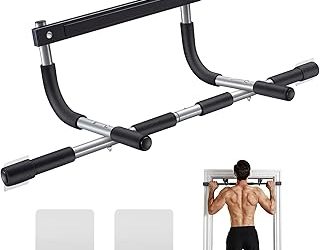
| Ally Peaks Multi-Grip Doorway Bar | Quiet controlled reps | Padded contact damps frame creak | More joints means more places to develop rattle |
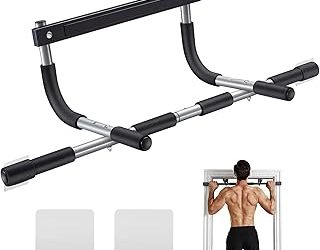
| Ally Peaks 440 lb Doorway Bar | Minimal flex under load | Rigid tube does not groan when loaded | Rigidity transmits vibration into the wall |
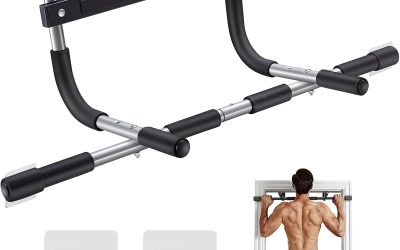
| Sportneer No-Drill Doorway Bar | Simple, few-part quiet setup | Fewer joints means fewer noise sources | Adjustment collar can tick if not fully locked |
| Upgrade Multi-Grip Bar with Larger Hooks | Eliminating shift noise | Tight hook seating stops the creak-and-shift cycle | Metal hooks on wood trim can squeak when dry |
| Ally Peaks Width-Adjustable Doorway Bar | Achieving a rattle-free fit | Width tuning removes the gap that causes movement | A loose lock is the loudest failure mode here |
| SPORTSROYALS Free Standing Power Tower | Isolating noise from walls | No wall contact at all when on a mat | Floor vibration still reaches the unit below |
How to Choose
- Eliminate movement: Almost all pull-up bar noise comes from tiny shifts under load. A bar seated with zero play is a bar that stays silent.
- Never drop off the bar: Step down or lower yourself. A controlled dismount is the single biggest noise reduction available and costs nothing.
- Use a mat: Rubber under a tower, or even under where you stand and step down, absorbs the impact that otherwise goes straight into a neighbor’s ceiling.
- Check the lock hardware: Adjustment collars that are not fully tightened produce a metallic tick on every rep. It is the most annoying sound in the category and the easiest to fix.
- Train at reasonable hours: Even a silent setup involves you moving around. Mid-morning and early evening cause far fewer complaints than 6 a.m.
Top Picks Reviewed
Best Damped Contact: Ally Peaks Multi-Grip Doorway Bar
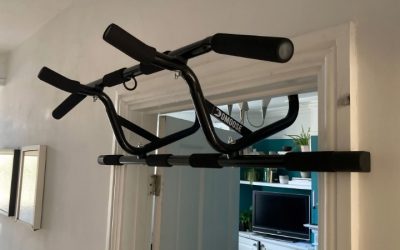
The padded leverage arms act as a damping layer between steel and wall, which cuts the creak that bare contact produces. Multiple grip positions also let you shift the load slightly and avoid working a single stressed contact point over and over.
More assembled joints means more potential rattles. If a squeak develops, it is usually at a bolted junction rather than the wall contact, and a quick re-torque resolves it.
Least Flex Noise: Ally Peaks 440 lb Doorway Bar
Thick tubing does not deflect meaningfully under body weight, and no deflection means no groaning from the steel or from the trim it presses against. Structurally quiet by virtue of being stiff.
Stiffness transmits rather than absorbs. Vibration from a fast rep travels efficiently through a rigid bar into the wall and onward into the adjacent unit. Controlled tempo matters here.
Fewest Noise Sources: Sportneer No-Drill Doorway Bar
A simple design with few parts has few places to develop noise. For a straightforward setup where you do strict reps and step down carefully, this is about as quiet as a doorway bar gets.
The adjustment collar is the exception. Not fully locked, it produces a distinct metallic tick every rep. Check it before each session and the problem never appears.
Most Shift-Resistant: Upgrade Multi-Grip Bar with Larger Hooks
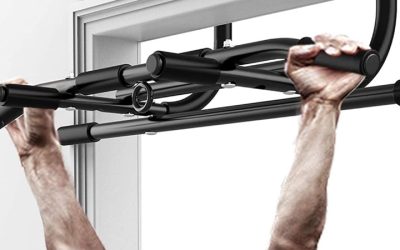
The creak most people hear is the bar micro-shifting against the frame and settling back. Larger hooks that grip more of the casing largely eliminate that cycle, which removes the noise at its source.
Bare metal hooks on dry painted wood can still squeak. A thin felt liner under each hook stops it and protects the trim at the same time.
Best Custom Fit: Ally Peaks Width-Adjustable Doorway Bar
A bar sized precisely to your opening has no gap to move within, and no gap means no rattle. For an out-of-square older doorway, adjustability is the most direct route to a silent installation.
Get the lock wrong and this becomes the noisiest option here, with a loose mechanism clicking on every rep. Verify the lock is fully engaged before you hang.
Best Wall Isolation: SPORTSROYALS Free Standing Power Tower
Nothing touches a shared wall, so nothing transmits into a neighbor’s living room. On a rubber mat, the frame is impressively quiet even during dips and knee raises.
Floors are still floors. Downward vibration reaches the unit below regardless of wall isolation, so a mat under the base is not optional in an upper-floor apartment.
Frequently Asked Questions
Why does my pull-up bar creak?
Almost always micro-movement between the bar and the door frame, or a bolted joint that has loosened. Re-tighten hardware and add felt at the contact points.
Do neighbors hear pull-ups through walls?
They hear the creaks and any dismount thud far more than the movement itself. A tightly seated bar and a controlled step-down make the exercise essentially inaudible.
Is a power tower quieter than a doorway bar?
Through walls, yes, because it never touches one. Through floors it can be worse if placed directly on hard flooring without a mat.
What is the quietest way to finish a set?
Lower yourself under control until your feet touch, rather than releasing at the top. The drop is where nearly all of the noise complaint originates.
Final Thoughts
Noise in this category is a fit problem, not a product defect. A bar seated with no play, hardware torqued properly, felt at the contact points, and a controlled dismount will keep the exercise essentially silent through a shared wall. If your building is unusually transmissive, a free-standing tower on rubber removes the wall from the equation entirely.


Write Your Review
No reviews yet. Be the first to share your experience!