
Key takeaways
- Start on your knees, always: Standing rollouts are an advanced movement. Knee rollouts with a limited range should be your entire program for the first several weeks.
- Limit range with a wall: Place the wheel so it stops against a wall at a distance you can control. This is the simplest and most reliable safety mechanism available.
- Watch the low back, not the abs: If your lower back arches during the rollout, you have exceeded your range. Stop there regardless of how the abs feel.
- Consider elbow support: Supporting the forearms shortens the effective lever and lowers the demand substantially, which is genuinely useful for building the pattern safely.
- Respect the return: The concentric pull back is where most people fail and where the spine gets loaded badly. Rebound assistance addresses this, but it should be a bridge rather than a permanent crutch.
What's inside
The ab wheel has a worse safety record than almost any other piece of cheap home equipment, and the reason is straightforward. A full rollout puts the spine into extension while the abdominal wall resists it, and if your core cannot generate enough tension, the lumbar spine takes the load instead. That is the mechanism behind the sharp lower back pain people report after their first enthusiastic session. It is not a mystery, and it is entirely preventable with a proper progression.
Which means the most important feature on an ab wheel is not the bearing or the grip material, it is whether the design lets you work in a partial range safely. Elbow supports and rebound assistance both help with that, though in different ways and with different tradeoffs. This roundup evaluates six wheels on how well each one supports a beginner working from a knee-based half rollout up to a full extension, and where the design encourages you to go further than your core is ready for.
As an Amazon Associate we earn from qualifying purchases at no extra cost to you. Product prices and availability are accurate as of the date shown and are subject to change.



Quick Comparison
| Product | Best For | Standout Feature | Watch Out For |
|---|---|---|---|
| Abiarst Ab Roller Wheel | Controlled partial rollouts | Simple design with predictable resistance | No assistance if you overreach your range |
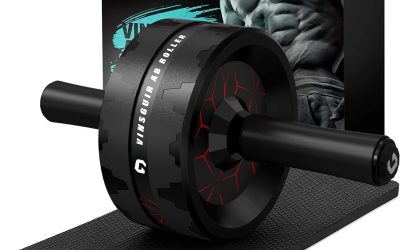
| VINSGUIR Ab Roller with Knee Pad | Beginners starting from scratch | Included pad encourages proper knee position | Nothing stops you rolling out too far |
| VINSGUIR Core Training Ab Roller | Steady progression over months | Stable platform for slow range increases | Demands honest self-limitation on range |
| Upgraded Ab Roller with Knee Mat & Timer | Structured session control | Rebound assist helps you return safely | Assistance can mask a weak core |
| Upgraded Rebound Ab Wheel with Elbow Support | Protecting the lower back | Elbow support shortens the lever arm | Reduced difficulty may stall progress later |
| Upgraded Ab Roller with Knee Pad | Full-body work once conditioned | Handles longer, more demanding sets | Full rollouts are unforgiving of fatigue |
How to Choose
- Start on your knees, always: Standing rollouts are an advanced movement. Knee rollouts with a limited range should be your entire program for the first several weeks.
- Limit range with a wall: Place the wheel so it stops against a wall at a distance you can control. This is the simplest and most reliable safety mechanism available.
- Watch the low back, not the abs: If your lower back arches during the rollout, you have exceeded your range. Stop there regardless of how the abs feel.
- Consider elbow support: Supporting the forearms shortens the effective lever and lowers the demand substantially, which is genuinely useful for building the pattern safely.
- Respect the return: The concentric pull back is where most people fail and where the spine gets loaded badly. Rebound assistance addresses this, but it should be a bridge rather than a permanent crutch.
Top Picks Reviewed
Best Simple Control: Abiarst Ab Roller Wheel
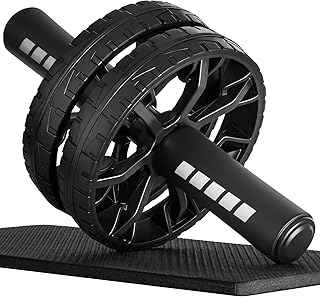
A basic wheel with predictable rolling resistance is easy to control at partial range, which is exactly what a careful progression needs. There is nothing here that encourages you to go further than you intend.
There is also nothing to catch you. If you roll past your controllable range, the only thing stopping the wheel is your core, and when that fails the floor and your lumbar spine share the job.
Best Beginner Setup: VINSGUIR Ab Roller with Knee Pad
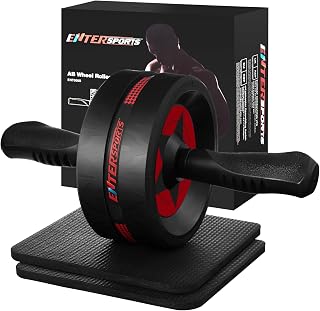
The included pad does more than protect the knees. It gives you a consistent starting position, and a consistent start makes it much easier to judge whether your range is genuinely increasing week to week.
Nothing in the design limits your range. A beginner feeling ambitious can roll out too far on rep one, which is precisely how the classic ab wheel back injury happens.
Best for Long-Term Progression: VINSGUIR Core Training Ab Roller
Stable and straightforward, this suits someone adding an inch of range every couple of weeks over several months. That patient approach is what actually builds a rollout, and this wheel does not get in the way of it.
It relies entirely on your self-discipline. On a day when you feel strong, nothing prevents you from adding six inches instead of one and paying for it the next morning.
Best Session Structure: Upgraded Ab Roller with Knee Mat & Timer
The timer encourages working in defined intervals rather than grinding to failure, which is a sensible way to accumulate volume without the fatigue that causes form breakdown. The rebound function assists the return phase where most people struggle.
Assistance can hide a weakness. If the spring is doing part of the concentric work, your core may not be as strong as your range suggests, and removing the assist later can be a surprise.
Best Back Protection: Upgraded Rebound Ab Wheel with Elbow Support
Resting the forearms shortens the lever between your shoulders and the wheel, which meaningfully reduces the torque your core must resist. For anyone with a history of low back trouble, this is the safest entry point in the group.
The reduced demand is also the ceiling. Once you are strong, the elbow-supported version stops being challenging, and you will want a standard wheel to keep progressing.
Best for Conditioned Users: Upgraded Ab Roller with Knee Pad
Once you can hold a hollow position and control a full knee rollout, this handles longer sets and more demanding full-body variations without any assistance getting in the way.
Full rollouts punish fatigue quickly. The last two reps of a long set are where form collapses and the back takes over, so cut sets short rather than chasing a number.
Frequently Asked Questions
Why does my lower back hurt after using an ab roller?
Almost always because your range exceeded what your core could stabilize, letting the lumbar spine extend under load. Reduce the rollout distance substantially and rebuild from there.
How far should a beginner roll out?
Only as far as you can go while keeping the pelvis tucked and the lower back flat. For many people that is a foot or less at first, and that is a legitimate starting point.
Are elbow-supported rollers worth it?
For beginners and anyone with back issues, yes. The shorter lever makes the movement accessible while still training the same pattern, though you will outgrow it.
How often should I use an ab wheel?
Two or three sessions a week is plenty. The abdominal wall recovers reasonably fast, but the connective tissue involved in resisting extension does not, and soreness here lingers.
Final Thoughts
The ab wheel is an excellent tool and a genuinely risky one used carelessly. Buy the version that matches your current core strength rather than your goal, set a physical range limit with a wall, and add distance in small increments. Almost every bad experience with this equipment comes from doing too much range on day one, and that is entirely within your control.
Write Your Review
No reviews yet. Be the first to share your experience!