
Key takeaways
- Measure jamb to jamb: Take the internal width at bar height, not door width and not the rough opening. Standard interior doorways land near 32 inches, but older houses vary widely and a half-inch error puts you outside an adjustable range.
- Check casing depth: Measure how far the trim stands proud of the wall. Under an inch suits standard hooks; anything deeper needs an oversized hook design or the bar will rock instead of seating.
- Confirm wall above: Leverage bars need three to five inches of flat wall above the casing. Crown moulding, a soffit, or a doorway close to the ceiling rules them out and pushes you toward a compression fit.
- Allow head clearance: Subtract your seated-to-crown height from the doorway height to check you can clear the bar at the top of a rep. Anyone over six feet should verify this before ordering rather than after.
- Verify the jambs are solid: Compression bars transfer force sideways into the frame. Knock on each jamb — a hollow sound means the frame is shimmed rather than tight to the studs, and lateral loading is a bad idea.
What's inside
Three measurements decide whether a doorway pull-up bar works in your home, and every one of them takes under a minute with a tape measure. Skip them and you join the large group of buyers who discover, mid-installation, that the bar is two inches too wide, that the hooks will not clear the architrave, or that their head hits the lintel at the top of every rep. Returns in this category run high for exactly this reason, and almost none of it is the product’s fault.
Measurement one is the internal frame width, taken jamb to jamb at roughly the height the bar will sit — not at the floor, because door openings are rarely perfectly parallel. Measurement two is casing depth, the distance the trim protrudes from the wall face, which determines whether the mounting hooks will seat. Measurement three is clear wall above the casing, since a leverage-style bar needs three to five inches of flat surface for its backplate. Write all three down, then compare them against the six bars below rather than the other way round.
As an Amazon Associate we earn from qualifying purchases at no extra cost to you. Product prices and availability are accurate as of the date shown and are subject to change.

#1 Pick

#2 Pick


#4 Pick

#5 Pick

#6 Pick

#7 Pick

Quick Comparison
| Product | Best For | Standout Feature | Watch Out For |
|---|---|---|---|
| Ally Peaks Pull Up Bar | Standard 32 in doorways | Thick-wall tube, 440 lb rating | Needs clear wall above the trim |
| Ally Peaks Multi-Grip Bar | Varying hand positions | Neutral and angled grips | Sits lower in the opening |
| Body-Solid PUB34 Bar | Non-standard widths | Width adjusts to the frame | Costs well above the average |
| Sportneer No-Drill Bar | 29.5-37 in openings | Compression fit, no wall contact | Requires regular re-tensioning |
| KAKICLAY Multi-Grip Bar | Deep architrave | Larger hooks clear thick trim | Poor fit on shallow flat casing |
| No-Screw Adjustable Bar | 29.1-37.4 in frames | 360-degree locking mechanism | Lock must be seated fully |
How to Choose
- Measure jamb to jamb: Take the internal width at bar height, not door width and not the rough opening. Standard interior doorways land near 32 inches, but older houses vary widely and a half-inch error puts you outside an adjustable range.
- Check casing depth: Measure how far the trim stands proud of the wall. Under an inch suits standard hooks; anything deeper needs an oversized hook design or the bar will rock instead of seating.
- Confirm wall above: Leverage bars need three to five inches of flat wall above the casing. Crown moulding, a soffit, or a doorway close to the ceiling rules them out and pushes you toward a compression fit.
- Allow head clearance: Subtract your seated-to-crown height from the doorway height to check you can clear the bar at the top of a rep. Anyone over six feet should verify this before ordering rather than after.
- Verify the jambs are solid: Compression bars transfer force sideways into the frame. Knock on each jamb — a hollow sound means the frame is shimmed rather than tight to the studs, and lateral loading is a bad idea.
Top Picks Reviewed
Best Overall: Ally Peaks Pull Up Bar
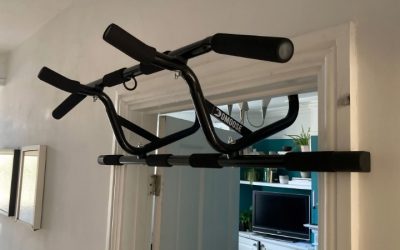
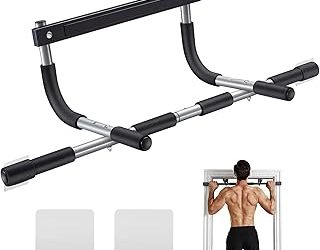
In a conventional doorway with sound trim and clear wall above, this is the default answer. The tubing is thicker than most competitors, which shows up as noticeably less flex when you hang at full extension, and the 440 lb frame rating is consistent with the steel used.
What it does not tolerate is a doorway without the required wall space above the casing. If your measurement three came in under three inches, this bar will sit at an angle and load the trim unevenly — a genuine safety issue rather than an inconvenience.
Best Grip Options: Ally Peaks Multi-Grip Bar
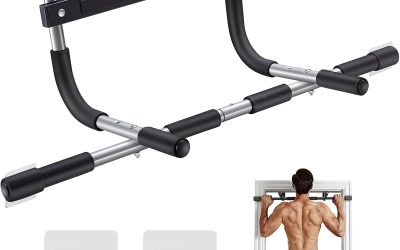
The additional handles let you rotate between pronated, neutral and angled positions, which spreads the load across different parts of the back and is considerably easier on the elbows over a long training block.
Those handles occupy vertical space in the opening. Measure your head clearance carefully, because this design effectively lowers the usable bar height and taller users can end up cutting reps short.
Best for Odd Widths: Body-Solid PUB34 Adjustable Bar
Older properties and converted spaces frequently have doorways that no fixed-width bar fits. The adjustable mechanism here has a wider useful range than most, and the build quality reflects Body-Solid’s commercial background.
You pay a clear premium for that. If your doorway is a standard 32 inches and your trim is ordinary, a cheaper bar will feel almost identical in use.
Best Compression Fit: Sportneer No-Drill Bar
When there is no usable wall above the doorway, this is the design that still works. It tensions across the 29.5 to 37 inch range and puts no load at all on the casing or the wall above.
The honest limitation is that tension decays. After a week of use the bar will be slightly looser than when you fitted it, and a loose compression bar can slip without warning. This needs a genuine pre-session check, not an occasional glance.
Best for Thick Trim: KAKICLAY Multi-Grip Bar
If measurement two came back over an inch — common with craftsman, colonial or Victorian architrave — most hooks simply cannot reach past the trim to bear properly on the wall. The enlarged hook geometry here solves that specific problem.
On thin, flat modern casing it becomes a disadvantage, holding the bar further out and increasing leverage on the trim. This is a fit-specific pick, not a general upgrade.
Best Tension Mechanism: No-Screw Adjustable Bar
The 360-degree locking collar makes tensioning more repeatable than a simple threaded rod, and the 29.1 to 37.4 inch range covers slightly narrower openings than most compression bars. For a doorway that sits just under the usual minimum, that extra reach matters.
The mechanism has to be fully seated to be safe. Users who tension it partway and assume the lock has engaged are the ones reporting slips. Turn until it stops, then confirm the lock has clicked home before loading it.
Frequently Asked Questions
What is a standard doorway width for a pull-up bar?
Most interior doorways measure between 30 and 33 inches jamb to jamb, which is why adjustable bars cluster around a 29 to 37 inch range. Always measure at the height the bar will sit rather than assuming the standard applies to your house.
How much space do I need above the door?
Leverage-style bars need roughly three to five inches of flat wall above the casing so the backplate can bear properly. Less than that and the bar sits crooked. Compression designs need none, which is why they exist.
Can I fit a bar in a doorway with a curved or arched top?
Leverage designs will not work because there is no flat wall to brace against. A compression bar can work if the jamb sides are straight and parallel where the bar sits, but check the fit carefully before loading it.
Does the bar need to be removed for the door to close?
Most doorway bars sit inside the frame at a height that clears the door swing, so the door usually still closes. Multi-grip models with lower-hanging handles are the exception and can foul on the door top edge.
Final Thoughts
Once you have your three measurements, the choice usually makes itself. A standard doorway with good trim and clear wall above points straight at the Ally Peaks Pull Up Bar. If the wall above is unusable, the No-Screw Adjustable Bar with its 360-degree lock covers the widest compression range and tensions more predictably than most. And for an unusual opening that neither fits, the Body-Solid PUB34 has the adjustment range and build quality to make an awkward doorway work.

Write Your Review
No reviews yet. Be the first to share your experience!