Key takeaways
- Match household sorting bins to your actual collection service, using an accepted-items worksheet and a practical removal route.
What's inside
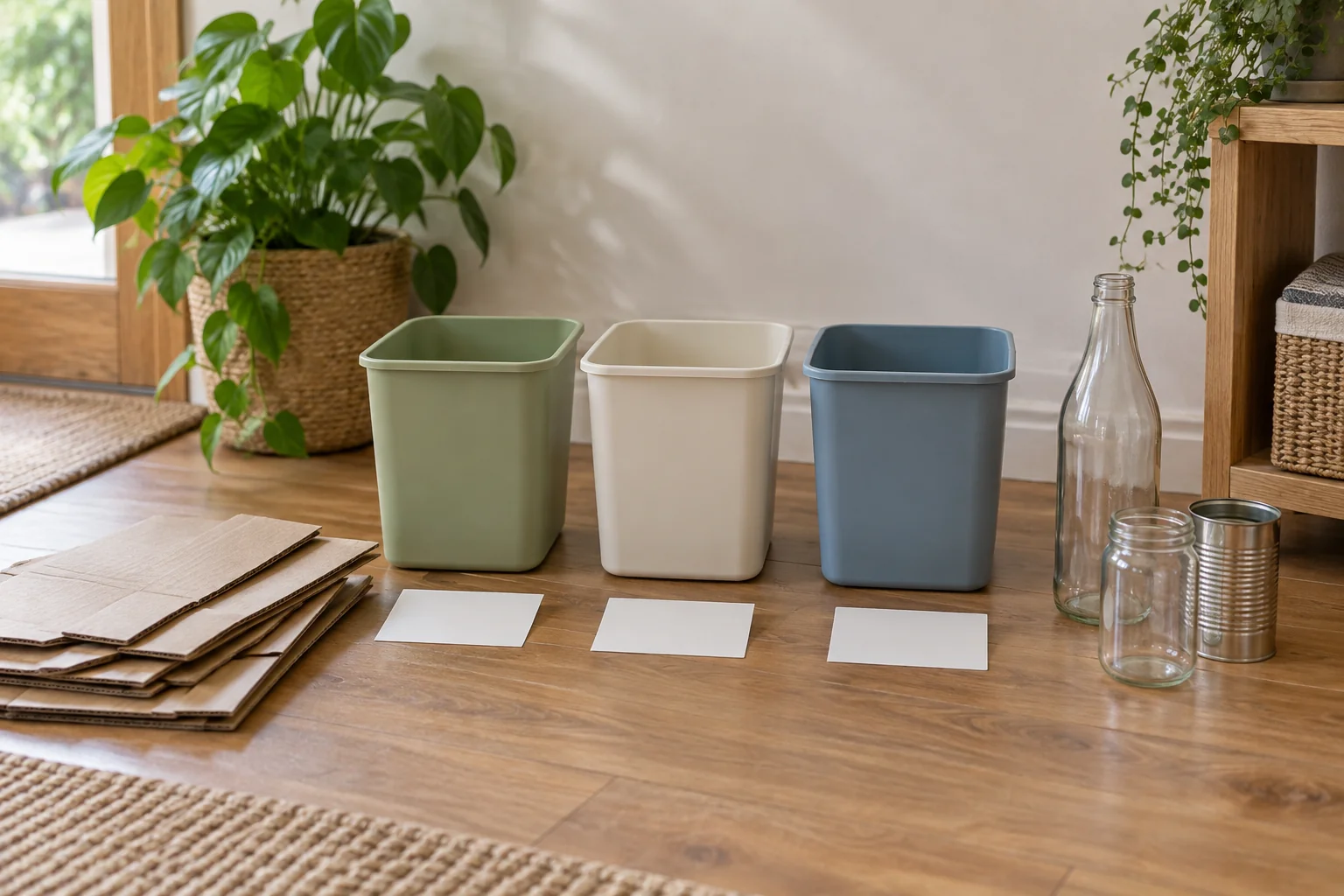
Build a household recycling station from your actual collection rules, then size and position the containers around the route items take through the home. Start with accepted materials and required preparation, not a set of attractive bins. The number or color of containers does not establish what your local service accepts.
This guide creates a household sorting and removal plan. It does not supply a universal recycling list. Your municipality, building manager or collection provider determines the relevant streams, preparation and collection arrangements.
Find the rules for the collection you really use
Save the official local page or collection notice and record when you checked it. In an apartment, confirm whether the building’s shared service differs from the municipal curbside service described online. A resident can sort carefully and still use the wrong stream if the building arrangements are assumed.
The EPA’s recycling FAQ advises checking local acceptance and notes that some programs collect materials together while others require separate streams. It also explains that a plastic resin code does not guarantee local recyclability. Use that principle to build your own accepted-items list rather than treating a symbol as permission.
Write down the exact distinctions that matter locally: whether glass is collected, whether materials must remain loose and where special drop-off items belong. Do not fill unknown fields from another city’s guide. Put the unresolved question beside the provider’s contact details.
Map the household’s common items
List the packaging and paper the household regularly handles, using real item names. “Drink bottle,” “delivery carton” and “food tub” are easier to act on than broad categories such as “green materials.” Match each item to the local rule and its required preparation.
Keep ordinary collection separate from special disposal. Batteries, electronics, sharps, chemicals and other potentially hazardous items should follow their specific local instructions, not be tossed into a miscellaneous station bin. This household layout is not a hazardous-waste storage plan.
EPA’s general guidance also distinguishes local curbside collection from items such as plastic film that may require other arrangements. Do not add a permanent drop-off container unless the household has confirmed an accepting destination and a practical way to take the material there.
Build a collection-rule worksheet
| Common item | Local accepted stream | Preparation | Home position | Removal plan |
|---|---|---|---|---|
| Delivery carton | Copy provider rule | Copy required preparation | Space for accepted prepared cartons | Collection day or building destination |
| Drink container | Confirm exact material/type | Follow local emptying and cap instructions | Assigned accepted-material bin | Named household task |
| Uncertain ordinary package | Unconfirmed | Do not guess | Brief decision area if appropriate | Check rule promptly |
| Special-disposal item | Separate official instructions | Follow those instructions | Outside this general station plan | Confirmed specialist route |
Use specific examples on the eventual bin labels, drawn from the verified worksheet. Avoid copying a broad online graphic whose pictures include items your provider rejects. Date the reference so a later change is easier to notice.
Size the station from a short observation period
Observe how much accepted material accumulates between actual removal opportunities. You do not need to keep dirty packaging as evidence: note item counts and approximate space as you follow the local preparation rules. Separate an unusual delivery day from the household’s ordinary pattern.
Choose containers you can access and empty without blocking doors, required access or normal movement. Include lids in their open position and the space needed to lift a removable inner bin. A container that fits beneath a counter may still be awkward to pull out when full.
Keep weight and handling practical for the people doing the task. Do not select a large container solely to reduce trips if it becomes difficult to carry. Follow the bin’s own load and use instructions, and use the building’s approved collection route.
Design the route, not only the bin row
Trace where items are emptied or prepared, where they wait and where they leave the home. A station beside the source can be useful, but it should not compete with food preparation, appliance operation or a narrow passage. Keep surfaces and containers maintained according to their materials and use.
For items requiring another destination, write who will take them and when. Without a removal plan, a small sorting station can turn into long-term storage. If the household cannot reliably use a special collection option, resolve that issue before expanding the station.
Worked example: fewer bins, clearer rules
In a fictional apartment building, the confirmed service accepts certain materials together in one stream and keeps cardboard in a separate shared area. The household originally planned four matching bins based on a photograph. After checking the actual rules, it instead creates one suitable mixed-stream container and a defined cardboard holding position.
A third proposed bin for uncertain plastics is not automatically added. The household first checks its common packaging against the provider’s list and uses a short decision note for unresolved items. It does not treat the plastic number as proof of acceptance.
The final trial includes carrying the prepared material to the building’s collection point. One container is too awkward through the doorway, so the household chooses a more manageable size. The example demonstrates a planning process, not collection rules for your address.
Keep the station current
Review labels when the provider changes its instructions or the household moves. Remove obsolete examples and keep the official reference accessible. A useful recycling station answers three questions clearly: what belongs here, what preparation is required and how it reaches the correct collection stream.