Key takeaways
- Organize a household noticeboard into actions, upcoming events and reference pointers with clear ownership and a practical removal routine.
What's inside
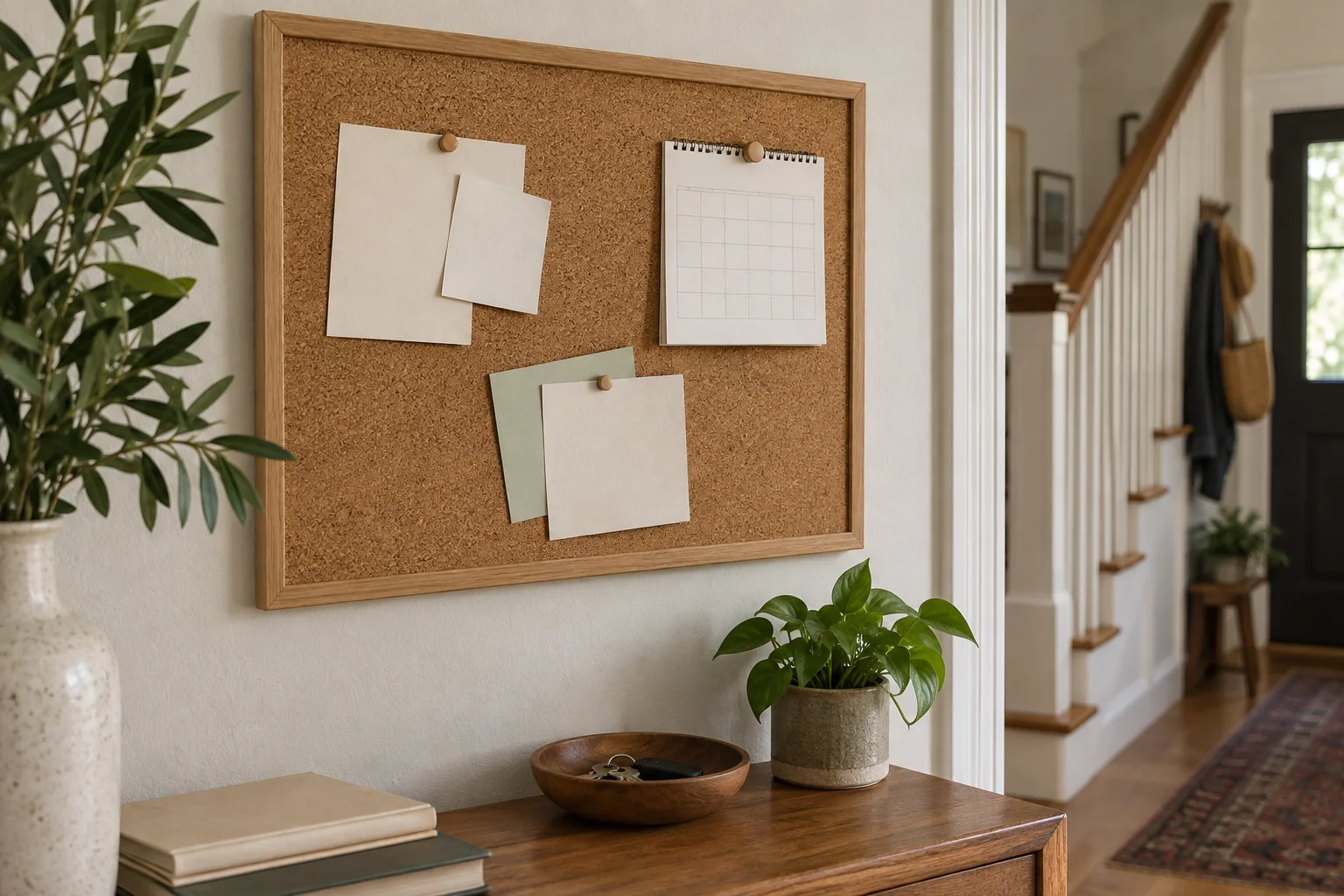
A readable household noticeboard separates things someone must do from information people may need later. Give each active note an owner, an action and a date for removal or review. The board then becomes a place to find the next useful step, rather than a permanent collection of papers whose importance is impossible to judge.
Start with the household’s actual communication needs. A board is helpful only if the people expected to use it can reach it, read it and understand what a note asks them to do.
Identify the questions the board should answer
Collect a few real examples of information that recently went missing: a delivery window, a shared-room booking or the date a borrowed item must be returned. Keep personal details out of any example you share publicly. Ask which of those messages belongs on a visible board and which belongs in a private record.
A noticeboard does not need to become the household’s entire filing system. Receipts, account information and old instructions can overwhelm the small amount of information needed today. Decide where reference documents live and use the board to point to them without exposing sensitive details.
Agree who can add a note and who can remove it. This is particularly useful when one person writes the message but another person completes the action. Without that agreement, a finished task can remain visible until nobody trusts the board’s current state.
Write one clear action per active note
The CDC Clear Communication Index recommends a main message and a clear call to action for communication materials. Applied here as an editorial principle, that means making the purpose of a household note obvious. The CDC guidance is not a validation of this particular board design.
Replace a heading such as “Package” with a concrete request: “Alex: bring the delivered parcel inside after work.” Add the relevant date or review point. The example uses a fictional name; use whatever identification your household finds clear without posting unnecessary personal information.
If a note contains several unrelated requests, divide it. A person should not have to read a long paragraph to discover that the final sentence applies to them. Keep enough context to explain the task, but move detailed instructions to the agreed reference location.
| Zone | What belongs here | Required detail | Removal rule |
|---|---|---|---|
| Action | Something a person needs to do | Owner, verb, date | Remove or mark complete when confirmed |
| Upcoming | A dated event or shared-space booking | Date, time if relevant, contact person | Remove after the event or a change |
| Reference pointer | Where stable instructions are stored | Document name and location | Review when the location changes |
Set a practical limit on visible content
Choose a board area that can be read comfortably from its intended position. Place a few sample notes there and ask the actual users to read them. If someone must move papers aside, lean around furniture or guess tiny handwriting, adjust the arrangement rather than declaring the board finished.
Set a household limit for active notes that fits this board and its users. There is no universal number. When a new message exceeds that limit, review the existing messages instead of shrinking the writing or layering another sheet over them.
Use spacing and clear headings before adding elaborate color codes. Color can help group information, but the meaning should remain understandable from words or position alone. A guest or a household member should not need to memorize a complex legend before finding today’s action.
Worked example: a board that was full of history
In a fictional household, a board contains twelve papers: old delivery slips, a current room booking, a repair appointment and several instructions. The household moves the historical papers to their appropriate records, places the current booking in “Upcoming” and writes one action note for the person handling the appointment.
A reference pointer names the folder containing the appliance instructions. The instructions themselves no longer cover half the board. Each dated note receives a review or removal date, and one person agrees to check the board during the household’s existing weekly planning conversation.
The board is not considered successful merely because it looks sparse. After using it, the household checks whether the booking was noticed and the appointment action was understood. If a message was missed, they revise its wording or placement rather than adding a larger decorative heading.
Handle changes without leaving contradictory notes
When a booking time changes, replace the old note or clearly mark it superseded. Do not rely on a second note elsewhere to correct the first. Record who made the change if the household needs that information to resolve a question.
For messages that need a response, provide a simple response method. That could be an agreed initial beside the action or a direct conversation with the owner. Avoid assuming that a note has been read merely because it has been on the board for several days.
Keep urgent or consequential communication in an appropriate direct channel. A board should not silently become the only way to deliver information that needs immediate acknowledgment.
Review the system, not just its appearance
Periodically remove expired notes and ask whether each zone still serves a purpose. If the board is mostly reference material, improve the filing system. If it is mostly repeated reminders, discuss whether the task ownership is clear.
The useful outcome is a board that answers “What concerns me, what do I need to do, and when can this note disappear?” Clear wording, a small visible workload and an agreed removal routine make those answers easier to find.