Key takeaways
- Record where and when exercise noise is noticed, with normal-use context and household timing, before deciding whether moving equipment could help.
What's inside
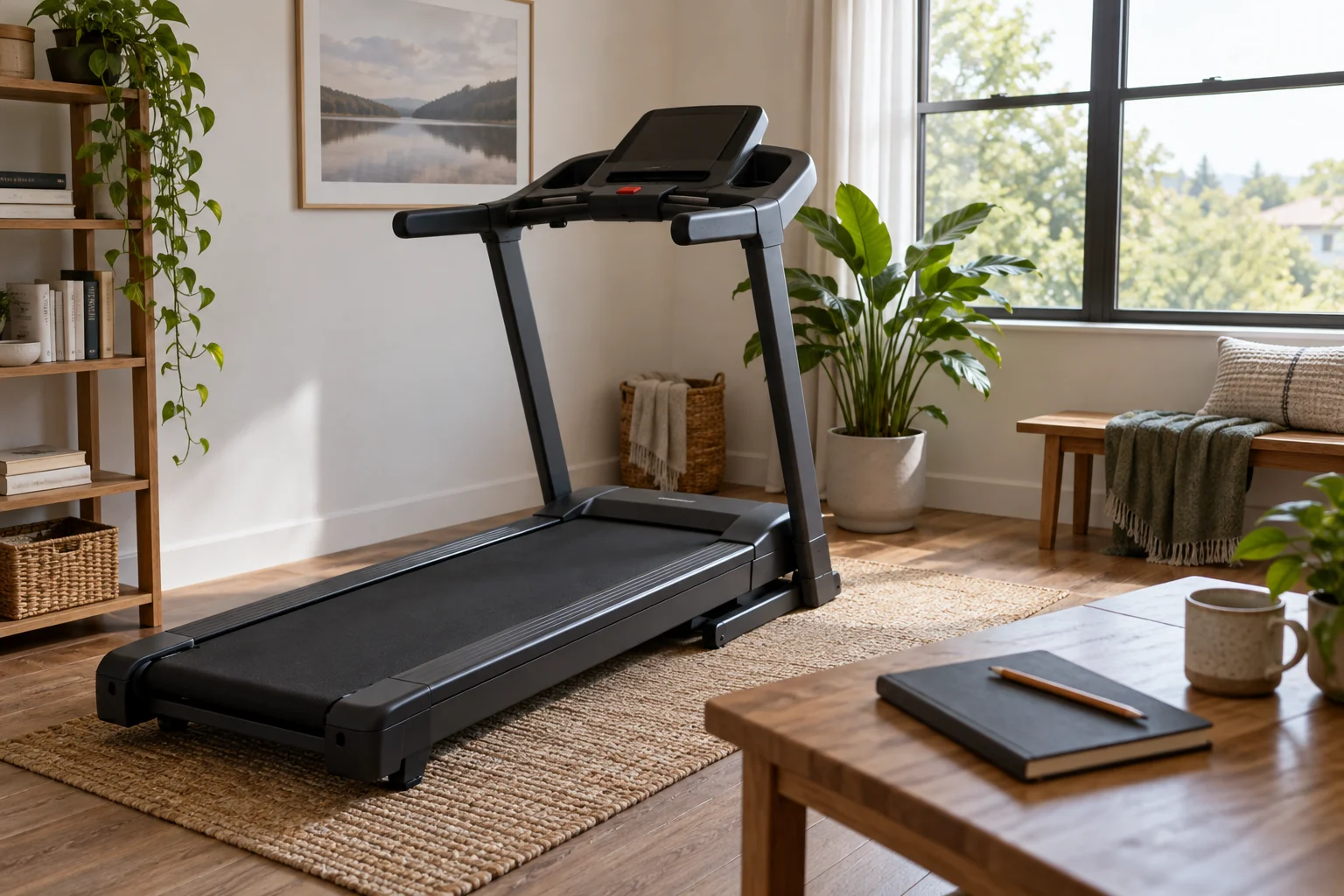
Record noise concerns before moving exercise equipment by describing what is heard, where it is heard and when it interferes with ordinary household activities. “The treadmill is loud” leaves too many questions unanswered. A short observation record can distinguish a location or timing problem from an equipment issue that needs manufacturer support.
Use observations from normal permitted use, not repeated runs designed to provoke a concerning sound. If the machine has an unfamiliar noise, damage or another sign of a fault, follow its stop-use and support instructions. Relocation is not a repair method.
Define the concern from the listener’s position
Ask the affected person to describe the sound in their own words and name the place where they notice it. A pulsing thump in the room below and audible television from the workout room are different concerns. Record the description without claiming to know the transmission path.
Note the activity being interrupted, such as a call, rest or reading. This gives the household a practical target for discussion. The aim might be avoiding a particular overlap rather than eliminating every audible sound throughout the home.
Do not enter another person’s private space or record their conversations to collect evidence. Agree on how observations will be shared. A simple written note usually provides enough information for the first planning conversation.
Record context with the observation
| Field | What to note | What not to infer |
|---|---|---|
| Time and duration | When the concern occurred | That every session has the same effect |
| Listener location | Room and ordinary position | A proven structural sound path |
| Equipment use | Known normal activity at that time | An unobserved mechanical fault |
| Other sound | Music, television or another appliance | That the exercise machine caused everything heard |
| Impact | Which activity was interrupted | A legal noise-limit conclusion |
Record settings only when they are known without distracting the user or approaching moving parts. “Not recorded” is an honest entry. Do not ask someone to increase speed or resistance to make a disturbance easier to document.
Keep room effects separate from machine condition
Horizon Fitness’s noise FAQ explains that background sound, flooring and proximity to walls can affect how treadmill noise is perceived or reflected. This supports recording the surroundings when describing a concern. It does not establish a diagnosis for your machine or guarantee that a mat or new position will solve it.
A suspected equipment problem belongs with the exact model’s instructions and support route. An ordinary operating sound that conflicts with a household activity may instead require a timing or room-use discussion. Keep those paths distinct so a practical compromise does not conceal an unresolved fault.
Look for patterns before proposing a move
Review a few naturally occurring observations. Does the concern appear only while another room is being used for calls? Is the audible element the equipment, accompanying music or both? Does it occur throughout a session or at one ordinary transition? These questions can reveal which information is still missing.
A lack of complaints does not prove silence. Ask for a clear account from the relevant users rather than assuming that nobody spoke up because the arrangement worked. Equally, one difficult evening should not become an unsupported claim about every future session.
A fictional household record
Imagine a stationary exercise machine in a spare room. On two evenings, a listener reports rhythmic sound during a video call in the next room. On another evening, the same general activity causes no reported conflict because the listener is elsewhere. The record identifies a recurring overlap but does not measure acoustic performance.
The household first considers a mutually workable session time. If moving the machine remains an option, they obtain the manufacturer’s placement and moving requirements and check the proposed room separately. They do not drag the equipment across the floor as an informal experiment or assume that a different corner will be quieter.
Describe a proposed change precisely
Name one change at a time: a different agreed time, a change to accompanying audio or a professionally assessed relocation. Write what observation would indicate that it helps. Avoid changing location, floor covering, operating routine and household schedule together if you want to understand which change matters.
Any new position still needs appropriate support, clearance, power and access according to the equipment and property requirements. A quieter impression does not prove a setup is suitable. Obtain qualified advice for building or acoustic questions that the household cannot resolve from ordinary observations.
Close the record honestly
State the outcome as a practical agreement: the conflicting time was avoided, the listener found the revised arrangement acceptable, or professional assessment remains needed. Do not label the result soundproofed or compliant with a noise limit without the relevant evidence.
Keep mechanical findings in the separate equipment inspection log. This observation sheet has a different job: helping household members discuss the disturbance clearly before committing to a move that may be difficult, costly or ineffective.