Our Top Picks
The Best Premium Automated Sliding Glass Door Systems with Smart Locks: A 2026 Buyer’s Guide
The best premium automated sliding glass door systems with smart locks are the ones that match your panel width, track height, structural header, and lock protocol to your actual wall opening — not the ones with the longest feature list. In practice that means measuring your rough opening first, choosing glass and frame materials second, sizing motor torque to panel weight third, and only then pairing a smart lock that supports a documented manual-release method during a power outage.
This guide covers panel widths and track heights, glass and frame material trade-offs, motor torque ratings, how smart locks pair and behave when the power dies, and situation-based picks for apartments, coastal homes, family houses, and accessibility retrofits. Prices are given as general 2026 market ranges for the hardware and motorization only, since installation, glazing specification, and finish choices move the final number substantially.

Sliding Door Smart Lock, Eseesmart Sliding Glass Door Lock with Fingerprint, Smart Mortise Lock with APP IC Card Code Keys, Patio Door Double Hook 2085 Mortise Lock Set with Handle
Chosen because it specifies Eseesmart Sliding Glass Door Lock with Fingerprint and Smart Mortise Lock with APP IC Card Code Keys.
View on Amazon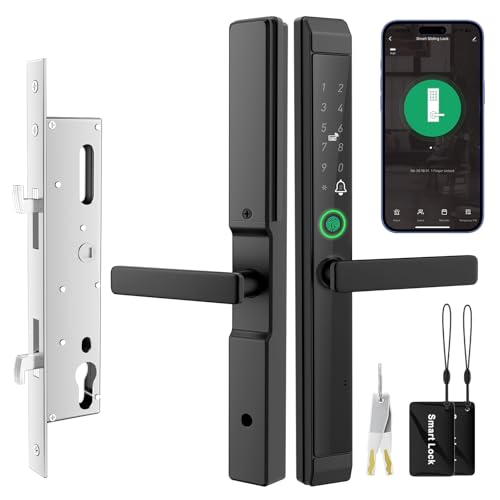
Sliding Door Smart Lock, Sliding Glass Door Lock with Fingerprint
Chosen because it specifies Sliding Glass Door Lock with Fingerprint.
View on Amazon
Sophies Glass Door Smart Lock for Sliding Doors, WiFi Keyless Entry Door Lock Frameless Remote Control Digital Sliding Swing Smart Deadbolt No Drilling Required (Glass Door Locks)
Picked as a relevant option in this category.
View on Amazon
Keylesslife Sliding Door Smart Lock,Sliding Door Lock Fingerprint,Smart Mortise Lock RFID APP Smart Lock Biometric Patio Door Lock Double Hook 2085 Mortise Lock Set with Handle
Chosen because it specifies Sliding Door Lock Fingerprint.
View on AmazonStart With Your Rough Opening, Not the Product Page
Almost every automation failure in residential sliding glass doors traces back to a door that was specified before the opening was measured. Before you compare a single product, you need four numbers:
- Rough opening width — the finished structural opening, measured at three heights (top, middle, bottom) and taken as the smallest value.
- Rough opening height — measured at both jambs, again taking the smallest.
- Header depth and available cavity — the space above the opening where a motor or drive rail can live. Many home automation motors need 4–6 in (100–150 mm) of clear vertical space above the track; concealed motors need more.
- Slab or panel thickness — standard residential sliding glass panels run 1¾ in (44 mm) for wood-clad frames and 2 in (50 mm) for thermally broken aluminum; oversized panels frequently go to 2¼ in (57 mm).
A useful rule of thumb: for a two-panel bypass configuration, each panel is roughly (opening width ÷ 2) + 3 to 4 in of overlap. So a 96 in opening yields panels around 51–52 in wide, and the clear passage when fully open is roughly half the opening minus the frame stiles. That clear passage number — not the opening width — is what decides whether a wheelchair, a stroller, or a large piece of furniture gets through.
Panel Widths, Track Heights, and What Fits
Residential automated sliding glass doors cluster into a handful of panel width bands. The band determines your hardware class, your motor size, and your price tier.
| Panel width band | Typical panel weight (per leaf) | Track / roller class | Motor class needed | Typical hardware + motor range |
|---|---|---|---|---|
| 24–36 in (610–915 mm) | 60–120 lb (27–54 kg) | Light-duty tandem roller, 1¾ in track | Low-torque belt drive | $600–$1,400 |
| 36–48 in (915–1220 mm) | 110–200 lb (50–91 kg) | Standard tandem roller, stainless raceway | Mid-torque belt or screw drive | $1,200–$2,600 |
| 48–60 in (1220–1525 mm) | 180–300 lb (82–136 kg) | Heavy-duty multi-roller, adjustable carriage | High-torque belt or chain drive | $2,200–$4,500 |
| 60–96 in (1525–2440 mm) oversized | 280–500 lb (127–227 kg) | Commercial-grade carriage, box track | High-torque screw or hydraulic drive | $4,000–$9,000+ |
Track height is the other half of the equation. Pocket and bypass tracks are usually 1¾–2 in tall for standard residential panels, but motorized units add a drive rail above or beside the track, which pushes the effective stack height to 3½–5 in. If you have a decorative header, a curtain pocket, or a low soffit, measure the finished clearance from the top of the track to the ceiling. In apartment retrofits, that clearance is frequently the binding constraint — not the width.
Three track configurations dominate premium systems:
- Surface-mounted top track — the motor and rail are visible above the opening. Easiest to service, least expensive, but visually heavy.
- Concealed or pocket track — the drive is hidden inside a header cavity. Cleanest look, requires 5–7 in (125–180 mm) of cavity depth, and service access must be designed in from the start.
- Floor-track systems — a bottom guide rail carries the load and a top rail only guides. Good for very heavy panels and multi-slide configurations, but the floor track is a trip hazard and traps debris.
For multi-slide configurations that stack panels into a pocket, expect each stacked panel to consume 1½–2 in of pocket depth plus 1 in of clearance. A four-panel stack of 36 in leaves needs roughly 10–12 in of pocket depth. Under-sizing the pocket is the most common and most expensive multi-slide mistake.
Glass and Frame Material Trade-offs
Automation hardware is roughly the same across brands at a given weight class; the glass and frame are where the money actually goes, and where performance is won or lost.
Glass Options
- Clear tempered monolithic glass — least expensive, thinnest (typically ¼ in / 6 mm), lightest, so it eases motor load. Poor thermal performance; condensation-prone in cold climates.
- Laminated safety glass — two panes bonded to a PVB or ionoplast interlayer. Better impact resistance and better acoustic performance (roughly 1–3 dB better than monolithic at similar thickness), but heavier, typically 5/16 in to ⅜ in (8–10 mm).
- Insulated glass unit (IGU) — double-pane with a warm-edge spacer and argon or krypton fill. Strong thermal performance when paired with a low-E coating. Each leaf typically weighs 2.0–2.5× a comparable monolithic leaf, which is the single biggest driver of motor sizing.
- Triple-glazed IGU — best thermal and acoustic performance, used in passive-house builds. Very heavy; at 48 in panels you are frequently at 250–320 lb per leaf, and the track, header reinforcement, and motor all escalate accordingly.
A useful estimate: an IGU leaf weighs roughly 5–6 lb per square foot for a 1 in unit. A 48 in × 84 in leaf is 28 sq ft, so about 140–170 lb of glass alone. Add 25–40 lb for a thermally broken frame and hardware, and you are at 165–210 lb per leaf. That number is what you feed into the motor sizing calculation.
Frame Options
| Frame material | Weight penalty | Thermal performance | Motor & track impact | Realistic service life |
|---|---|---|---|---|
| Thermally broken aluminum | Low | Good with polyamide break | Lowest motor demand; narrow sightlines | 20–30 years |
| uPVC / vinyl | Low–moderate | Very good | Low motor demand; limited color stability in harsh sun | 15–25 years |
| Wood-clad aluminum | Moderate–high | Excellent | Higher motor demand; needs reinforced header | 25–40 years with maintenance |
| Solid wood | High | Good if properly sealed | Highest motor demand; moves with humidity | 20–35 years with regular refinishing |
| Steel (thermally broken, commercial) | Very high | Moderate | Requires commercial-grade drive; heaviest track class | 30–50 years |
For automated doors specifically, thermally broken aluminum is usually the best trade-off: it keeps leaf weight down, which lets you use a smaller motor, a lighter track, and a less reinforced header. Wood-clad aluminum looks better in traditional interiors but pushes you up a full motor class at the same panel size. Solid wood is workable but requires the most careful humidity control and the most frequent hardware adjustment.
Motor Torque Ratings and How to Size Them
Motor torque is usually specified in the manufacturer’s literature either as a rated torque (in-lbf or Nm), a holding force (lbf or N), or simply a maximum panel weight. The maximum panel weight number is the most useful, but it is almost always quoted with a safety margin already removed, and it assumes a well-aligned track. Real-world derating matters.
A practical sizing rule: choose a motor rated for at least 1.5× your actual leaf weight, and 2× if the door is exterior and exposed to wind or temperature swing.
| Motor class | Typical rated torque | Rated max leaf weight | Recommended actual leaf weight | Typical opening speed | Noise at 3 ft |
|---|---|---|---|---|---|
| Low-torque belt drive | ~15–25 Nm | 150 lb (68 kg) | ≤100 lb (45 kg) | 6–8 in/s | 38–45 dB |
| Mid-torque belt drive | ~25–45 Nm | 280 lb (127 kg) | ≤185 lb (84 kg) | 8–12 in/s | 42–50 dB |
| High-torque belt or chain | ~45–80 Nm | 450 lb (204 kg) | ≤300 lb (136 kg) | 10–14 in/s | 48–56 dB |
| Screw or hydraulic drive | ~80–160 Nm | 800 lb (363 kg) | ≤530 lb (240 kg) | 4–10 in/s (higher force, lower speed) | 50–60 dB |
Three torque realities that product listings rarely mention:
- Breakaway torque is higher than running torque. A door that has sat closed for weeks in humid weather needs more force to start moving than to keep moving. Motors without soft-start ramps will strain their gearboxes on the first cycle of the season. Look for a soft-start/soft-stop ramp as a standard feature.
- Cold weather increases seal drag. Weatherstripping stiffens below about 40°F (4°C) and can add 15–30% to required breakaway force. If the door faces prevailing winter wind, go up a motor class rather than down.
- Track contamination is the number-one torque killer. A dusty or grit-laden track can double effective friction within a year. Any premium system should offer a brush or wiper pre-cleaner riding ahead of the roller, and the track should be vacuum-accessible.
Open/close cycle rating is the other motor spec worth reading. Residential-grade operators are typically rated 10,000–25,000 cycles; commercial-grade operators 100,000–500,000 cycles. A household that runs the door 20 times a day will hit 7,300 cycles a year, so a 25,000-cycle unit is a three-to-four-year device before service. If you plan to keep the door for a decade, either buy a higher cycle rating or accept a motor replacement mid-life and confirm the operator is user-replaceable without removing the panels.
Smart Lock Pairing on Sliding Glass Doors
Sliding glass door locks fall into four families, and only some of them integrate with home automation in a useful way.
- Hook-bolt or mortise latch with electric strike — the most robust and the most common in premium systems. The lock is mechanical; an electric strike or motorized latch retractor is the smart part. Lock status is genuinely sensed, not inferred.
- Motorized deadbolt on a stile — a cylinder drives into the jamb or an adjacent panel. Simple, widely compatible with retrofit smart locks, but the stile must have enough internal depth (usually 1⅜–2⅛ in) and enough backset room.
- Electromagnetic or magnetic latch — quiet, low-profile, but typically fails secure or fails open depending on wiring, and requires continuous power to stay locked. Not ideal for a main exterior door.
- Floor or threshold bolt — common on multi-slide and lift-slide doors. Automating these is possible with a motorized floor bolt, but they are the most expensive to retrofit and the most sensitive to floor flatness.
Protocols and What “Pairing” Actually Means
Premium 2026 systems generally expose one or more of: Matter over Thread, Zigbee, Z-Wave, Bluetooth LE, and a manufacturer cloud API. The practical differences:
- Matter over Thread — best for local control and multi-ecosystem use. Requires a Thread border router. Pairing is by QR code and is usually the fastest path to Apple Home, Google Home, Alexa, and SmartThings simultaneously.
- Z-Wave — mature, reliable, long range, excellent for locks specifically because it has a well-defined lock device class. Requires a hub.
- Zigbee — similar to Z-Wave in practice, sometimes cheaper, occasionally more sensitive to interference from 2.4 GHz Wi-Fi.
- Bluetooth-only — fine as a backup channel, poor as a primary. No remote access without a bridge, and no reliable automation triggers.
The single most important pairing question is whether the lock reports true state or assumed state. A lock that only reports “commanded to lock” is useless in an automation that arms a security system. Look for a bolt-position sensor or a strike sensor that reports physical engagement. This is the difference between a lock that pairs and a lock you can actually build routines on.
Second most important: whether the automation controller can request a lock without also commanding the door to close. Many motorized door controllers bundle “close and lock” into one command. That is fine for a bedtime routine, but it is dangerous if a pet or a child is in the threshold. Any premium system worth buying should let you lock without closing, close without locking, and hold the door in a partial-open position with the lock disengaged.
Manual Override and Behavior During a Power Outage
This is the specification most buyers skip and most regret skipping. Every motorized sliding glass door should be evaluated on three outage questions:
- What happens to the lock when power fails?
- What happens to the motor and drive when power fails?
- How do you get the door open, and how long does it take?
Lock Behavior
- Fail-secure (standard for exterior doors) — the lock stays engaged without power. Good for security; means you cannot exit that way in a blackout unless there is a manual thumb-turn. Always confirm the interior side has a manual release accessible without tools.
- Fail-safe — the lock releases without power. Required in many commercial egress applications; generally not appropriate for a residential exterior door because it opens the house in an outage.
- Battery-backed fail-secure — the lock holds its state and also accepts commands on battery for a defined period. Common in premium systems; typical backup is 6–12 months of normal use or 8–24 hours of continuous standby, depending on the lock. This is the configuration most buyers actually want.
Motor and Drive Behavior
- Mechanical clutch release — a lever or knob on the operator disengages the drive, after which the door slides by hand. This is the gold standard. It works with zero power, zero battery, and zero network.
- Manual-pull-through gearing — some belt drives can be pushed open by hand against the motor with moderate force. Feels heavy and is hard on the gearbox over time; acceptable as a fallback, not as a plan.
- Battery backup — the operator runs on internal batteries for a set number of cycles during an outage. Typical premium units quote 20–100 cycles. Useful, but batteries age, and a pack that has never been exercised will often not deliver the rated cycles after two years. Test it annually.
- Integral UPS or low-voltage bus backup — the most capable option, especially where the door is part of an egress path. Adds cost and a battery location that must be ventilated and accessible.
Whatever the mechanism, run one drill: kill the breaker to the door, wait two minutes, and open and close the door by hand. Time it. Then have every adult in the household do it. A door that takes 40 seconds and a tool to open is not an egress door; a door that opens in five seconds with a pull of a lever is. This single test tells you more about a premium system than any datasheet.
Also confirm what happens on partial power loss — for example, if the lock’s batteries die but house power is fine, or if the network drops but the motor has power. The best systems degrade in independent layers: lock, motor, and network each have their own fallback, so no single failure locks you out or leaves the door open.
Decision Matrix: Which Configuration Fits Your Situation
| Your situation | Panel width | Glass / frame | Motor class | Lock approach | Budget range (hardware + motor) |
|---|---|---|---|---|---|
| Small apartment, retrofit, no header cavity | 24–36 in, two-panel bypass | Laminated, thermally broken aluminum | Low-torque belt, surface-mounted track | Motorized deadbolt on stile, Matter over Thread | $700–$1,600 |
| Kids and pets, high cycle count | 36–48 in | Laminated or IGU, aluminum | Mid-torque belt with obstruction sensing | Hook bolt + electric strike, true state reporting | $1,400–$3,000 |
| Coastal or high-wind exposure | 36–48 in | Laminated, thermally broken aluminum with stainless hardware | High-torque belt or chain | Fail-secure motorized bolt with stainless components | $2,200–$4,500 |
| Accessibility retrofit, wheelchair or walker use | 36–48 in single slide | IGU for thermal comfort, aluminum | Mid-torque with soft start/stop and low threshold | Hook bolt with remote release, battery-backed | $1,800–$3,800 |
| Whole-wall multi-slide, entertaining space | 48–96 in, 3–5 panels | Triple IGU, wood-clad aluminum | Screw or hydraulic drive, 2× derating for wind | Floor bolts plus stile bolt, layered failover | $5,000–$12,000+ |
| Rental or reversible install | 24–36 in | Laminated, aluminum, surface-mounted everything | Low-torque belt, renter-removable operator | Retrofit smart deadbolt, no jamb modification | $600–$1,300 |
If you are between two tiers, move up on the motor and stay in the middle on glass. Motor undersizing is the failure that costs the most to fix, because it usually means a new operator, a new track, and sometimes new panel hardware. Upgrading from laminated to IGU later, by contrast, means replacing glass only.
Real Measurements That Decide the Purchase
These are the numbers worth having on paper before you request quotes.
- Clear passage width. For a two-panel 72 in opening, expect 32–35 in of actual walk-through clearance. Below 32 in, accessibility gets tight; below 30 in, it is a problem for wheelchairs and most strollers.
- Threshold height. Standard sliding door tracks sit ¾–1½ in above the finished floor. Low-threshold or flush-track systems get to ⅜–½ in but require a recessed sill and cost meaningfully more.
- Furniture clearance around the opening. An automated door needs a clear approach on both sides. Plan 36 in of clear floor space perpendicular to the door face, and do not place a sofa, console, or dining chair within 18 in of the track line if you want the door to be usable while furniture is occupied.
- Header reinforcement. A motor bracket typically needs 2× blocking or a steel plate within the header. If you are framing new, add the blocking before drywall. If you are retrofitting, a surface-mounted track avoids the need for reinforcement entirely.
- Power and data. Most operators need a dedicated 120V circuit, and the smart lock either shares that circuit via a low-voltage transformer or needs its own. Plan one receptacle inside the header cavity and one within reach of the lock stile. If you want a wired network, plan for a low-voltage run at the same time; retrofitting after finishes is the most expensive part of the project.
- Leaf weight per panel. Measured or calculated. This is the number that determines motor class. Multiply square footage by 5–6 lb/sq ft for a 1 in IGU, add frame and hardware weight, and then apply the 1.5× derating factor.
- Cycle count you actually expect. Count household members, pets, and daily routines. Twenty cycles a day is a realistic busy household figure; that is 7,300 cycles a year.
What Wears First on an Automated Sliding Door
Durability questions usually come down to which component fails first and how expensive it is to replace.
- Rollers and carriage — typically the first to go, usually 5–10 years on a heavy exterior door. Replacement is inexpensive if the track is a standard profile and the panel can be lifted out.
- Weatherstripping and seals — 3–7 years depending on sun exposure. Cheap part, but a stiff seal directly increases motor load, so a neglected seal shortens motor life.
- Drive belt or chain — 7–12 years. Replacement is a moderate job and usually requires removing the operator cover.
- Motor and gearbox — 8–15 years at residential cycle counts, often the second major expense after the original install.
- Lock batteries and latch mechanism — batteries annually; the latch mechanism itself 8–15 years.
- Control board and network module — the wildcard. Electronics often fail before mechanics, and a discontinued module can force a full operator replacement. Favor systems that document a compatible replacement path for the control module.
Roller and seal replacement is the reason to insist on a standard track profile and accessible carriage. A proprietary track with captive rollers can turn a $40 part into a $1,500 service call.
Common Mistakes in Premium Automated Sliding Door Projects
- Specifying the door before the opening is measured. Measure at three points, take the smallest, and confirm the header cavity before selecting a motor.
- Ignoring leaf weight. A motor rated at 280 lb is not appropriate for a 200 lb oversize IGU leaf in a windy exposure. Apply the 1.5×–2× derating rule.
- Hiding the operator with no service access. Concealed tracks are beautiful until the belt needs replacing. Design an access panel.
- Choosing a lock that infers state instead of sensing it. This breaks every meaningful automation and every security routine.
- Skipping the outage drill. Never assume manual override works. Test it, time it, and teach it to everyone in the household.
- Forgetting the network. A Matter over Thread lock needs a Thread border router within range. A Z-Wave lock needs a hub with adequate mesh density. Plan the radio path before you plan the trim.
- Under-sizing the pocket for multi-slide. Each stacked panel takes 1½–2 in of pocket depth plus clearance. A four-panel stack needs roughly 10–12 in.
- Buying the finish first. Finish options narrow the field fast; the motor, glass, and lock specification should drive the shortlist, not the anodized color.
Frequently Asked Questions
Can a smart lock be added to an existing automated sliding glass door?
Usually yes, if the stile has enough internal depth for the lock body and there is a backset path through the frame. The limiting factors are stile width (most retrofit locks need at least 1⅜ in of usable depth) and whether the existing latch can be replaced or must be worked around. Electric-strike retrofits are generally easier than full lock-body swaps because they replace only the jamb-side component.
How heavy a sliding glass panel can a residential motor move?
Residential operators on the market in 2026 span roughly 150 lb to 800 lb of rated leaf weight, with the practical recommendations sitting at about two-thirds of that. Above roughly 500–600 lb per leaf, most residential designs give way to commercial-grade hardware. Always size to 1.5× your actual leaf weight, and 2× for exposed exterior doors.
What happens if the power goes out while the door is open?
On a fail-secure system with a mechanical clutch release, the door simply stays where it is and can be slid closed by hand. On a system without a clutch, you may need to push the panel against motor resistance, which is possible on belt drives but hard on the gearing. If the lock is battery-backed, it can usually still be engaged or disengaged from the interior. This is exactly why the outage drill matters.
Do automated sliding doors work with Matter and Apple Home or Google Home?
Increasingly yes, via Matter over Thread or a manufacturer bridge. The important caveat is feature parity: a door may appear in an ecosystem as a simple open/close accessory while lock state, partial-open positions, and obstruction alerts remain manufacturer-app-only. If those features matter to you, confirm the exact exposed capabilities before buying.
Is a top-hung or bottom-rolling system better for automation?
Top-hung systems carry the panel weight on an overhead track and carriage. They are generally easier to automate, easier to service from above, and produce less floor clutter, but they require a more substantial header. Bottom-rolling systems distribute load to the floor and are common on very heavy multi-slide doors, but the floor track complicates automation, cleaning, and accessibility.
How much should I budget for a premium automated sliding glass door?
For a single-leaf or two-panel residential system with a smart lock, general 2026 market ranges run from about $600–$1,300 for a light retrofit setup to $4,000–$9,000 or more for an oversized multi-slide with concealed drive and layered failover. Whole-wall multi-slide configurations with triple glazing and commercial-grade operators regularly exceed $12,000 on hardware and motorization alone, before glazing upgrades, structural reinforcement, and finish work.
How often should the track and rollers be serviced?
Vacuum the track and wipe the roller raceway every three months in normal conditions, and monthly in dusty or coastal environments. Have rollers, carriage, and seals inspected annually. Track contamination is the single largest cause of premature motor failure, so this maintenance pays for itself quickly.
The Short Answer
Buy by opening, not by feature list. Measure the rough opening in three places, work out your leaf weight from glass area and frame type, size the motor at 1.5× that weight (2× for exposed exterior doors), choose thermally broken aluminum unless the interior design demands wood, and pick a lock that senses physical bolt position and pairs locally over Matter or Z-Wave. Then do the one test that matters: cut the power, count the seconds until the door is open by hand, and make sure every adult in the house can do it too. A premium automated sliding glass door is the one that still opens when nothing else works.