Key takeaways
- Check exact game editions, count components and track missing or damaged pieces with a ready-to-play status and publisher request record.
What's inside
Organize a shared board-game collection by checking each exact edition against its component list, recording missing items and separating ready-to-play boxes from unresolved sets. A full-looking box is not necessarily complete, and a missing piece does not always mean the whole game needs replacing.
The goal is to know what can be played as intended before the group sits down. A small inventory also makes it easier to ask the publisher for the right part without guessing from an online photograph of another edition.
Identify the edition before counting
Write the game title, publisher, product number, language and any edition information from the box and instructions. Keep expansions separate from the base game unless the rules explicitly combine their inventories. Similar names and matching box colors do not prove that component quantities are identical.
Hasbro’s official instruction library accepts searches by brand, product name and product number. Its listings distinguish titles by product codes, including separate Game of Life entries. Use that kind of exact identification when retrieving a component list rather than assuming the first search result describes your box.
If you cannot identify the edition, photograph its identifying labels for a support request. Do not claim a component is missing based solely on another owner’s count. Mark the set “inventory unconfirmed” until you have a suitable reference.
Count one game on a clear surface
Work on one box at a time so pieces from two games cannot migrate into each other. Keep food and drinks away from the counting area. Follow the game’s age guidance and keep small components away from children who should not handle them.
Separate components by the categories in the official list: cards, tokens, player pieces, boards and accessories. Count matching items together, then check any unique pieces individually. A deck containing the expected total can still have one duplicate and one missing card, so use card identities where the game’s list makes that possible.
Record damaged items separately from absent ones. A bent card that is identifiable from its back creates a different problem from an unused spare marker. Do not hide both under a single “mostly complete” description.
| Component | Expected reference | Found | Condition or action |
|---|---|---|---|
| Player pieces | Count and colors in instructions | Count by color | Identify the exact missing type |
| Cards | Deck and identity list if supplied | Count and identities checked | Separate duplicates or marked cards |
| Dice or spinner | Specified type | Present or absent | Do not assume another type is equivalent |
| Boards and inserts | Required play components | Present or absent | Distinguish packaging from game parts |
| Instructions | Exact edition reference | Paper or official download | Save source and product code |
Give every box a useful status
Use three clear states: ready as intended, awaiting a named part, or inventory not yet confirmed. Put the status where someone choosing a game will see it, without damaging the original box artwork or covering identifying information. A removable sleeve or separate shelf card may suit a shared collection.
Do not automatically substitute a coin, different die or card from another set. A replacement can alter visibility, random outcomes, handling or the information available to players. Check the publisher’s guidance. If the group knowingly uses an agreed house rule, record it as a variation rather than describing the set as complete.
Contact the publisher with the product code and precise component description. Replacement availability and policies can vary; the inventory is useful whether the answer is a supplied part, another official remedy or no replacement. Keep the request and response with the record.
Worked example: a count reveals two separate problems
In this fictional example, a game’s identified instructions call for sixteen player pieces, four in each of four colors. The household finds fifteen pieces: four each in three colors and three in the fourth. It records one missing piece of that color rather than merely “one token missing.”
The card deck has the expected total of forty, but an identity check finds one repeated card and one absent card. The box therefore has two unresolved issues. Adding an unrelated token would not resolve the deck, and the correct total alone would have missed it.
The keeper marks the box awaiting parts and sends the publisher the exact details. These counts are invented for the example and are not the inventory of a named commercial game. Use the component list for the edition you actually own.
Make returning a game easier than recounting everything
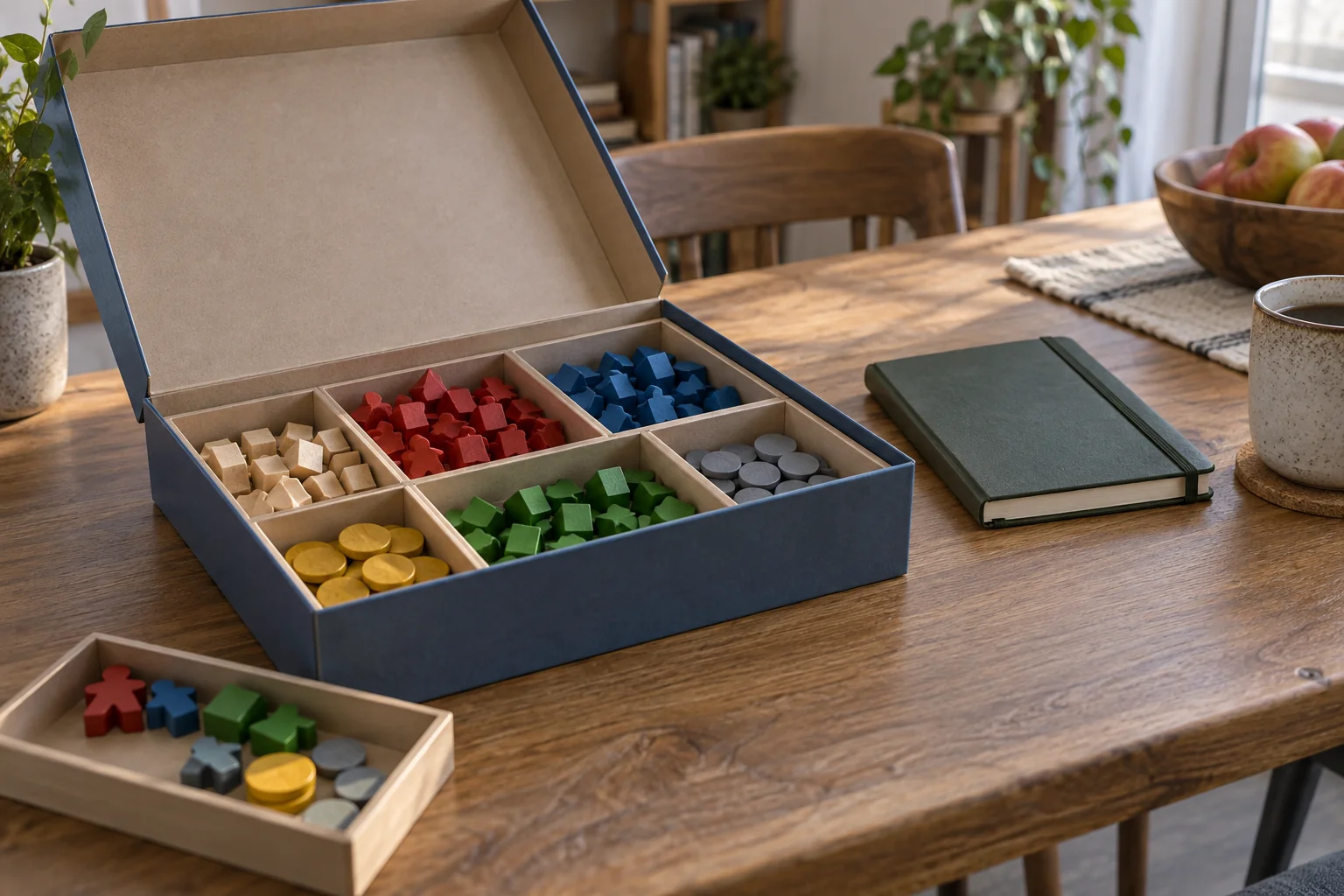
Store each game’s pieces in compartments or suitable labeled containers within its own box, following any product-specific storage directions. Keep the component checklist with the instructions. A packing photograph can help show where items belong, but it should not replace the written count or imply that hidden pieces are present.
After play, assign someone to check the small components before clearing the table. Note a new loss immediately instead of relying on memory next week. For borrowed games, record the handover and return condition without publishing other people’s personal details.
Keep unresolved boxes separate enough that they are not chosen accidentally, but give each an action and review date. The result is a collection people can understand at a glance: ready to play, waiting for a specific fix, or still needing identification.